Table of Contents
Introduction
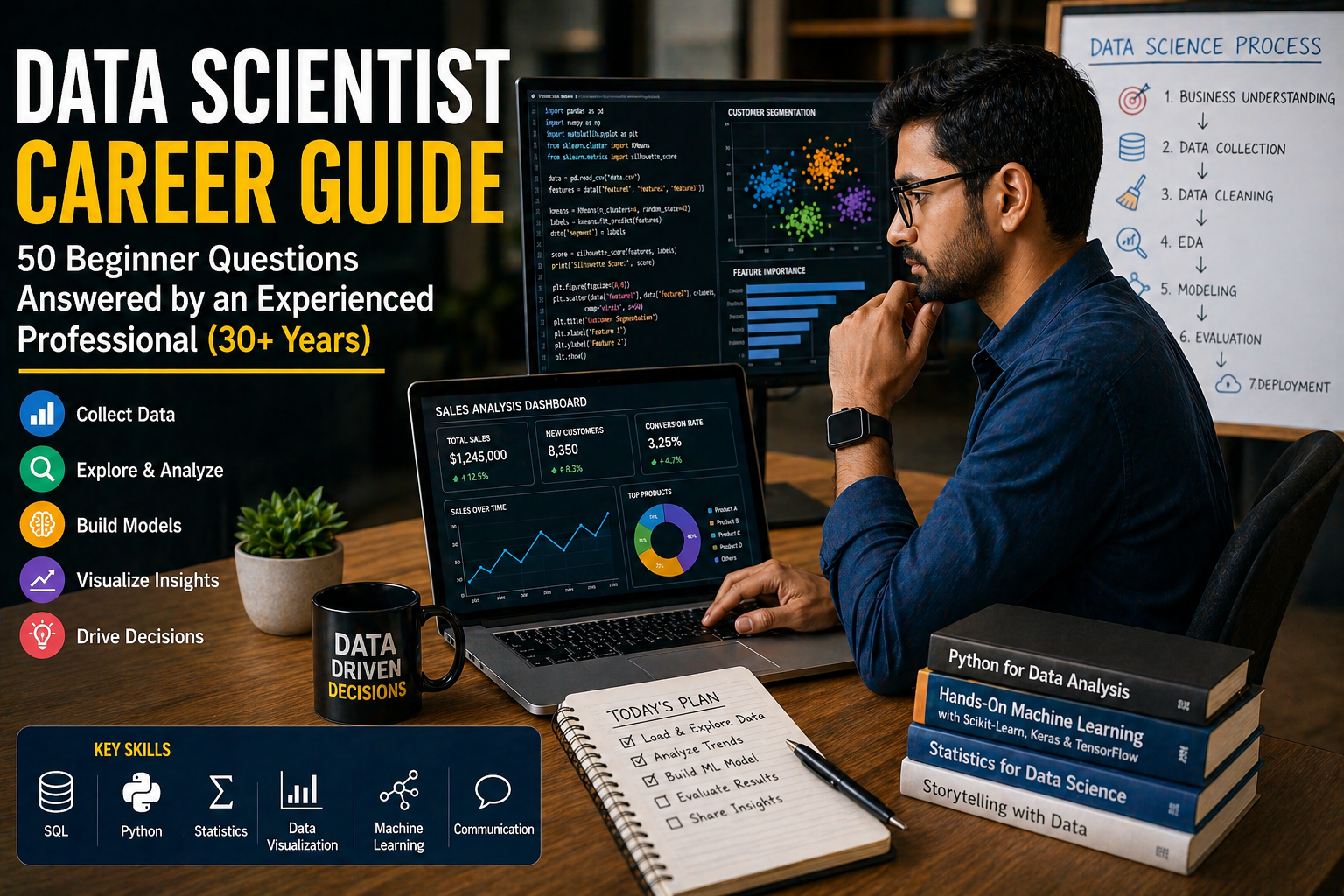
Data science is one of the most important careers in the modern digital economy, but it is also one of the most misunderstood. Many beginners think a Data Scientist spends the whole day building advanced machine learning models. In reality, the job is much broader. A Data Scientist helps organizations understand data, find patterns, answer business questions, make predictions, and support better decisions.
If I were speaking to you as a 50–60-year-old professional with decades of experience, I would tell you this first: data science is not magic, and it is not only about tools. It is about judgment. You need to know how to ask the right question, collect the right data, clean it carefully, analyze it honestly, explain your findings clearly, and avoid misleading people with numbers.
A good Data Scientist sits between business, statistics, technology, and communication. You may work with product managers, marketers, finance teams, engineers, executives, doctors, retailers, or operations managers. Your job is not just to produce charts or models. Your job is to help people understand what is happening and what they should do next.
This career is good for people who enjoy problem-solving, patterns, logic, business questions, programming, and continuous learning. It is not a perfect fit for people who want quick answers without patience. Much of the work involves cleaning messy data, checking assumptions, explaining uncertainty, and sometimes telling people that the data does not support the answer they wanted.
In this guide, I will answer 50 beginner questions about becoming a Data Scientist in a realistic, practical, and human way.
50 Beginner Questions About Becoming a Data Scientist
1. What does a Data Scientist actually do?
A Data Scientist uses data to answer questions, solve problems, and support decisions. In real work, that may mean analyzing customer behavior, predicting sales, finding why users leave a product, measuring marketing performance, detecting fraud, improving recommendations, or helping leadership understand trends.
The daily work usually includes collecting data, cleaning it, exploring it, building reports, creating visualizations, running experiments, training models, and explaining findings. Beginners often imagine the job is mostly machine learning, but in many companies, the most valuable work is simply helping people understand what the data really says.
A good Data Scientist is not only technical. You must understand the business question behind the numbers. If a manager asks, “Why are sales down?” you do not immediately build a model. You first ask better questions: Which product? Which region? Which time period? Which customer group? Data science starts with curiosity and careful thinking.
2. Is Data Science still a good career?
Yes, Data Science is still a strong career, but it has matured. A few years ago, many people entered the field because it sounded glamorous and high-paying. Today, companies are more practical. They want Data Scientists who can create business value, not just run models in notebooks.
The demand is strong because businesses collect more data than ever. Websites, apps, payments, customer systems, marketing platforms, logistics tools, and sensors all produce information. But raw data is not useful by itself. Companies need people who can turn it into insight.
However, competition is real. Beginners must build practical skills: SQL, Python, statistics, visualization, business thinking, and communication. AI tools can help with analysis, but they do not replace human judgment.
If you enjoy solving problems with evidence, Data Science can be a meaningful career. But if you only like the title and dislike messy data, you may struggle.
3. What is the difference between a Data Scientist and a Data Analyst?
A Data Analyst usually focuses on describing what happened. They create dashboards, reports, summaries, and business insights. They answer questions like: How many customers bought this month? Which campaign performed best? Why did traffic drop?
A Data Scientist often goes deeper into prediction, experimentation, statistics, and machine learning. They may answer questions like: Which customers are likely to leave? What price change may improve revenue? Which factors drive conversion? Can we predict demand next month?
There is overlap. In many companies, Data Scientists do plenty of analysis, and Data Analysts may use advanced methods. The difference depends on the company.
For beginners, do not worry too much about the title. Build the foundation first. Learn SQL, Python, statistics, visualization, and business communication. These skills help in both roles. Many strong Data Scientists started as Data Analysts.
4. What is the difference between a Data Scientist and a Machine Learning Engineer?
A Data Scientist focuses more on analysis, experimentation, insights, modeling, and decision support. A Machine Learning Engineer focuses more on building, deploying, scaling, and maintaining machine learning systems in production.
For example, a Data Scientist may build a model to predict customer churn and explain which factors matter most. A Machine Learning Engineer may turn that model into a reliable service that runs every day inside the company’s product.
In smaller companies, one person may do both jobs. In larger companies, the responsibilities are more separate. Data Scientists often work closer to business teams, while Machine Learning Engineers work closer to software and infrastructure teams.
If you enjoy statistics, business questions, storytelling, and analysis, Data Science may fit you better. If you enjoy software engineering, deployment, APIs, and systems, Machine Learning Engineering may feel more natural. Both paths are valuable.
5. Do I need strong math to become a Data Scientist?
You need enough math to understand data and models, but you do not need to be a genius mathematician. The most important areas are statistics, probability, linear algebra basics, and some calculus if you go deeper into machine learning.
Statistics matter most in everyday Data Science. You need to understand averages, distributions, variance, correlation, sampling, confidence intervals, hypothesis testing, and uncertainty. Without statistics, it is easy to mislead yourself and others.
Many tools can run calculations for you, but tools cannot think for you. If you do not understand what a metric means, you may make bad recommendations.
My advice is to learn math gradually through real problems. Do not wait until you master every formula. Build projects, meet situations where math matters, then study the theory behind them. Practical context makes math less frightening and more useful.
6. What programming language should I learn first?
Python is usually the best first programming language for Data Science. It is widely used, beginner-friendly, and has powerful libraries such as pandas, NumPy, matplotlib, scikit-learn, and many others. Python helps you clean data, analyze patterns, build models, and automate work.
But SQL is just as important. Many beginners focus on Python and ignore SQL. That is a mistake. In real companies, data often lives in databases, and you must know how to retrieve it. A Data Scientist who cannot write SQL will be limited.
Start with Python and SQL together. Learn Python for analysis and modeling. Learn SQL for extracting and joining data.
Later, you may learn R, depending on your field. R is common in statistics, research, and some analytics teams. But for most beginners, Python plus SQL is the strongest starting point.
7. What skills should a beginner learn first?
Start with SQL, Python, statistics, and spreadsheets. These are the practical foundations. SQL helps you get data. Python helps you clean and analyze it. Statistics help you understand it. Spreadsheets help you communicate simple results quickly.
Then learn data visualization. A chart can explain a pattern faster than a long paragraph, but only if it is designed honestly. Learn bar charts, line charts, scatter plots, histograms, and dashboards.
After that, learn machine learning basics: regression, classification, clustering, model evaluation, overfitting, and train-test splits. Do not jump directly into deep learning before you understand simple models.
Finally, learn communication. A Data Scientist must explain findings to people who may not understand code. If your analysis cannot influence a decision, it has limited value. Technical skill plus a clear explanation is the real combination.
8. How long does it take to become job-ready?
If you already know some programming or analytics, you may become ready for junior Data Science or analytics roles in 8 to 15 months of serious study and project work. If you are starting from zero, it may take 18 to 30 months or more.
But time is not the main measure. The real question is: what can you do? Can you write SQL queries? Can you clean messy data? Can you create charts? Can you explain a trend? Can you build a simple model and evaluate it honestly? Can you present insights clearly?
Many beginners spend too much time watching courses. Courses are useful, but projects make you job-ready. Build portfolio projects from raw data to final explanation.
Do not rush. Data Science rewards careful thinkers. A slower learner who builds strong foundations often becomes better than someone chasing shortcuts.
9. What kind of projects should I build?
Build projects that look like real business problems. Good beginner projects include customer churn analysis, sales forecasting, marketing campaign analysis, product recommendation, fraud detection, website traffic analysis, pricing analysis, loan risk prediction, or employee attrition analysis.
A good project should not only show code. It should explain the problem, data source, cleaning steps, analysis, visualizations, model if needed, findings, limitations, and recommendations. This shows that you think like a Data Scientist, not just a coder.
Avoid copying the same famous beginner datasets without adding your own thinking. If you use a common dataset, ask better questions, and present your own analysis.
Employers like projects that are clear and practical. A simple project with a strong explanation is better than a complicated model nobody understands. Your portfolio should prove judgment, not just tool usage.
10. What is the hardest part of Data Science?
The hardest part is not writing code. The hardest part is dealing with messy questions and messy data. In real companies, people often ask unclear questions, and the data is rarely clean. You may spend hours discovering that important fields are missing, duplicated, inconsistent, or measured incorrectly.
Another hard part is explaining uncertainty. Business leaders often want simple answers, but data may show a complicated picture. A good Data Scientist must say, “Here is what we know, here is what we do not know, and here is the risk of this conclusion.”
The third hard part is impact. You can do beautiful analysis, but if nobody uses it, it does not matter. You must connect your work to decisions.
Data Science is a thinking job. Tools help, but judgment is what makes the work valuable.
11. What is data cleaning?
Data cleaning means fixing problems in raw data before analysis. This includes handling missing values, removing duplicates, correcting formats, checking outliers, standardizing categories, fixing dates, and making sure columns mean what people think they mean.
Beginners often dislike data cleaning because it feels boring. Professionals know it is one of the most important parts of the job. If your data is wrong, your analysis will be wrong. Clean charts built from dirty data can mislead people badly.
For example, if customer records are duplicated, your revenue per customer may look lower than reality. If dates are formatted incorrectly, trends may appear false. If missing data is ignored, conclusions may be biased.
Data cleaning is not just technical work. It requires understanding the business process that created the data. Good Data Scientists respect this step deeply.
12. What is exploratory data analysis?
Exploratory data analysis, often called EDA, is the process of looking at data to understand patterns, problems, relationships, and surprises before making conclusions. It usually includes summary statistics, charts, grouping, filtering, and asking many questions.
EDA helps you understand what you are working with. How many rows are there? What values are missing? Are there unusual spikes? Are some categories much larger than others? Do variables seem related? Are there strange errors?
Beginners sometimes skip EDA and jump straight to modeling. That is a mistake. If you do not understand the data, you may build the wrong model or answer the wrong question.
EDA is like walking around a house before renovating it. You need to see the structure, cracks, and hidden problems first. A careful Data Scientist explores before concluding.
13. What is statistics used for in Data Science?
Statistics helps Data Scientists understand uncertainty, variation, relationships, and evidence. Data is rarely perfect. You usually work with samples, incomplete information, noisy measurements, and changing conditions. Statistics help you avoid false confidence.
For example, if sales increased after a new campaign, statistics help you ask whether the campaign caused the increase or whether it may be a random variation. If two groups behave differently, statistics help you decide whether the difference is meaningful.
Statistics is also important for experiments, forecasting, machine learning evaluation, risk analysis, and business reporting.
Without statistics, Data Science becomes dangerous because numbers can look convincing even when the conclusion is weak. A responsible Data Scientist does not only calculate. They ask whether the calculation supports the decision. Statistics keep you honest.
14. What is correlation, and why can it be misleading?
Correlation means two things move together. For example, ice cream sales and beach visits may both increase in summer. They are correlated. But that does not mean ice cream sales cause beach visits. A third factor, warm weather, may influence both.
This is why people say correlation does not prove causation. Beginners often see a relationship in data and quickly assume one thing caused another. That can lead to bad business decisions.
Correlation is useful as a clue. It can suggest patterns worth investigating. But you need more evidence before claiming cause and effect. Experiments, domain knowledge, time order, and careful analysis matter.
A professional Data Scientist is careful with language. Instead of saying “X caused Y,” you may say “X is associated with Y, but further testing is needed.” That honesty protects decision-makers.
15. What is causation?
Causation means one thing directly influences another. For example, if lowering a product price leads to more purchases, the price may be a cause of increased sales. But proving causation is harder than finding correlation.
In business, causation matters because decisions are based on actions. If you wrongly believe one thing causes another, you may invest money in the wrong solution.
The strongest way to test causation is often an experiment, such as an A/B test. You compare a treatment group and a control group while keeping other factors as balanced as possible.
Causation can also be studied with statistical methods when experiments are not possible, but that requires care.
A good Data Scientist does not casually claim causation. They explain the evidence level. This is one of the most important signs of professional maturity.
16. What is an A/B test?
An A/B test is an experiment where users are split into two or more groups to compare different versions of something. For example, one group sees the old website button, and another group sees a new button. Then you measure which version performs better.
A/B testing is common in websites, apps, marketing, product design, pricing, and emails. It helps teams make decisions based on evidence rather than opinions.
But A/B testing must be designed carefully. You need enough users, clear metrics, proper randomization, and enough time. If you stop too early or measure too many things randomly, you can fool yourself.
A Data Scientist often helps design, analyze, and explain experiments. The goal is not only to find a winner. The goal is to learn what actually improves user behavior or business results.
17. What is machine learning in Data Science?
Machine learning is a set of methods that allow computers to learn patterns from data and make predictions or classifications. Data Scientists use machine learning when the goal is not only to understand the past, but to predict or automate decisions.
For example, machine learning can predict whether a customer may cancel, whether a transaction is suspicious, what product a user may like, or how much demand a store may have next week.
But machine learning is not always needed. Sometimes, a simple chart or SQL analysis answers the business question. Beginners often want to use models everywhere because models feel impressive. Professionals choose the simplest method that solves the problem.
Machine learning is powerful, but it depends on good data, clear goals, careful evaluation, and responsible use. A model is only useful if it helps make real decisions.
18. What is supervised learning?
Supervised learning is a type of machine learning where the model learns from examples that already have correct answers. For example, if you have past customer data labeled as “churned” or “not churned,” the model can learn patterns that predict future churn.
Common supervised learning tasks include classification and regression. Classification predicts categories, like spam or not spam. Regression predicts numbers, like price, sales, or temperature.
Supervised learning is widely used because many business problems have historical examples. But the quality of labels matters. If the past labels are wrong or biased, the model will learn from those problems.
A beginner should understand that supervised learning is not magic. You give the model examples, it learns patterns, and then you test whether those patterns generalize to new data. The testing part is essential.
19. What is unsupervised learning?
Unsupervised learning is machine learning where the data does not have labeled answers. The model tries to find patterns, groups, or structure on its own. A common example is clustering customers based on behavior.
For example, an e-commerce company may not know its customer segments. Unsupervised learning can help group customers into patterns like frequent buyers, discount seekers, one-time shoppers, or premium customers. These groups can support marketing or product strategy.
Unsupervised learning is useful for exploration, but it requires interpretation. The model may create clusters, but humans must decide what those clusters mean and whether they are useful.
Beginners should be careful not to overtrust unsupervised results. Just because an algorithm found groups does not mean those groups matter. Always connect findings back to the business context and user reality.
20. What is a predictive model?
A predictive model uses data to estimate what may happen in the future or to which category something belongs. For example, it may predict future sales, customer churn, loan risk, product demand, or delivery delays.
Predictive models can help businesses act earlier. If you know which customers are likely to leave, you can offer support before they cancel. If you can forecast demand, you can manage inventory better.
But predictions are not guarantees. A model gives an estimate based on patterns in data. If the world changes, the prediction may become less accurate.
A good Data Scientist explains both the prediction and the uncertainty. You should never present model output as the perfect truth. The value of prediction is better decision-making, not fortune-telling. Responsible communication is part of the job.
21. What is model evaluation?
Model evaluation means checking how well a model performs on data it has not seen before. This is important because a model may look good during training but fail in real life.
Evaluation depends on the problem. For classification, you may use accuracy, precision, recall, F1 score, ROC-AUC, or a confusion matrix. For regression, you may use mean absolute error, mean squared error, or root mean squared error.
But metrics must match the business problem. In fraud detection, missing fraud may be worse than falsely flagging a normal transaction. In email spam detection, too many false positives may annoy users.
A professional Data Scientist does not only report a metric. They explain what the metric means and what kind of mistakes the model makes. Evaluation is where technical performance meets business consequences.
22. What is overfitting?
Overfitting happens when a model learns the training data too closely and performs poorly on new data. It is like a student memorizing practice questions but failing when the exam changes slightly.
A model can overfit when it is too complex, the dataset is too small, or the model trains for too long without proper control. The danger is that performance looks excellent during training, giving false confidence.
To reduce overfitting, Data Scientists use train-test splits, cross-validation, regularization, simpler models, more data, and careful feature selection.
Beginners often become excited when training accuracy is very high. Professionals immediately ask: how does it perform on unseen data? That question matters more.
Overfitting teaches an important life lesson in Data Science: looking good in the past does not always mean working well in the future.
23. What is a dashboard?
A dashboard is a visual display of important metrics and trends. Businesses use dashboards to monitor performance, such as sales, website traffic, customer activity, marketing results, support tickets, or financial numbers.
A good dashboard helps people make decisions quickly. It should be clear, focused, and easy to understand. A bad dashboard is full of charts nobody uses.
Data Scientists may build dashboards or work with analysts and business intelligence teams. The important part is choosing the right metrics. Just because you can measure something does not mean it belongs on a dashboard.
Beginners often make dashboards too crowded. Professionals ask: Who will use this? What decision will it support? How often will they check it? What action should happen if a metric changes?
A dashboard is not a decoration. It is a decision tool.
24. What is data visualization?
Data visualization means using charts, graphs, and visual design to communicate data clearly. It helps people see patterns, trends, comparisons, and outliers faster than tables of numbers.
Common visualizations include line charts for trends, bar charts for comparisons, scatter plots for relationships, histograms for distributions, and maps for geographic data.
But visualization must be honest. Bad chart choices can mislead people. For example, cutting the y-axis can exaggerate differences. Using too many colors can confuse readers. Showing percentages without sample size can hide important context.
A good Data Scientist uses visualization to clarify, not impress. The best chart is often simple. If your audience understands the point quickly and accurately, the visualization did its job.
Data storytelling depends heavily on good visuals.
25. What is data storytelling?
Data storytelling means explaining data findings in a way that helps people understand and act. It combines analysis, visuals, context, and narrative. You are not inventing a story. You are guiding the audience through the evidence.
For example, instead of showing ten random charts, you explain: “Sales dropped mainly in one region, among returning customers, after delivery times increased.” That tells decision-makers where to look.
Good storytelling includes the question, the evidence, the insight, the recommendation, and the uncertainty. It should be clear enough for non-technical people.
Beginners often present all the work they did. Professionals present what the audience needs to know. That is a big difference.
Data storytelling is one of the most valuable skills in this career. If people cannot understand your analysis, they cannot use it.
26. Do Data Scientists need business knowledge?
Yes, business knowledge is extremely important. Data does not exist in isolation. It comes from customers, products, sales, operations, marketing, finance, or real-world processes. If you do not understand the business, you may analyze the wrong thing.
For example, a drop in website conversion may not be a website problem. It may be a pricing change, a traffic source change, a shipping issue, or a seasonal trend. Business context helps you avoid shallow conclusions.
A good Data Scientist asks questions before coding. What decision are we trying to make? Who will use this analysis? What would change if we knew the answer? What does success mean?
Technical skill gets you into the field. Business understanding makes your work valuable. Companies do not pay for analysis only. They pay for better decisions.
27. How do Data Scientists work with executives?
Data Scientists work with executives by translating complex data into clear business insights. Executives usually do not need every technical detail. They need to know what is happening, why it matters, what choices they have, and what risks exist.
When speaking with executives, be direct. Start with the main finding. Then support it with evidence. Avoid hiding behind complicated charts or technical language.
Executives often ask big questions, such as why revenue changed, where growth is coming from, or which customers are most profitable. You must break these broad questions into measurable parts.
A good Data Scientist is honest with executives. If the data is weak, say so. If the conclusion is uncertain, explain it. Trust grows when leaders know you are not manipulating numbers to please them.
28. How do Data Scientists work with product teams?
Product teams use data to understand users and improve features. A Data Scientist may help analyze user behavior, measure feature adoption, run experiments, identify drop-off points, and predict retention.
For example, a product manager may ask why users stop during onboarding. The Data Scientist can analyze steps, user segments, device types, traffic sources, and timing to find patterns.
Product teams need fast but careful insights. They may not want a long research paper. They need practical answers that guide product decisions.
A good Data Scientist works closely with product managers and designers. You learn what users are trying to do, then use data to support better experiences.
In product work, numbers and user empathy should work together. Data tells you what is happening. User research helps explain why.
29. How do Data Scientists work with marketing teams?
Marketing teams use data to understand campaigns, audiences, channels, conversions, customer acquisition costs, and return on investment. A Data Scientist may help measure which campaigns bring valuable customers, not just clicks.
For example, one campaign may bring cheap traffic but low-quality leads. Another may cost more but produce loyal customers. Data Science helps marketing teams see beyond surface metrics.
You may also build customer segmentation, attribution models, lifetime value analysis, churn predictions, or A/B tests for landing pages and emails.
Marketing data can be messy because users move across channels, devices, and time. Attribution is rarely perfect. A good Data Scientist explains limitations clearly.
The goal is not to criticize marketing. The goal is to help spend money smarter, understand customers better, and improve results with evidence.
30. How do Data Scientists work with engineers?
Data Scientists work with engineers when data needs to be collected, stored, processed, or deployed into systems. Engineers help build reliable pipelines, databases, APIs, and production infrastructure. Data Scientists help define what data is needed and how it will be used.
For example, if you need to analyze user behavior, engineers may need to track events correctly in the product. If tracking is wrong, analysis becomes unreliable.
A good relationship with engineers is important. Do not throw unclear requests at them. Explain the purpose, fields needed, timing, and expected use.
Engineers also help turn models into production systems. If your model needs to run daily or serve users in real time, engineering support is essential.
Data Science is a team sport. Respect the people who make the data available and reliable.
31. What tools do Data Scientists use?
Common tools include SQL, Python, Jupyter Notebook, pandas, NumPy, scikit-learn, matplotlib, Tableau, Power BI, Excel, Git, cloud platforms, databases, and sometimes Spark for big data. Some Data Scientists also use R, depending on the industry.
But tools are not the heart of the career. Tools change. The core skills are asking good questions, cleaning data, analyzing honestly, modeling carefully, and explaining clearly.
For beginners, start with SQL, Python, Excel, or Google Sheets, and one visualization tool. Then add machine learning libraries and Git. Later, learn cloud and big data tools if your work requires them.
Do not try to learn every tool at once. Build projects with a small set of tools first. Depth is better than collecting software names.
32. Is Excel still useful for Data Scientists?
Yes, Excel is still useful. Many companies use spreadsheets every day, and many business users are comfortable with them. A Data Scientist who refuses to use Excel may create distance from non-technical teams.
Excel is good for quick checks, simple summaries, pivot tables, basic charts, and sharing small datasets. It is not ideal for large-scale analysis, reproducible workflows, or advanced modeling, but it still has a place.
Beginners should not look down on Excel. It teaches practical thinking about rows, columns, formulas, and business users. But do not stop there. Learn SQL and Python for more serious work.
A professional uses the right tool for the situation. Sometimes that is Python. Sometimes that is SQL. Sometimes,s a clean spreadsheet is exactly what the business needs.
33. What is SQL used for?
SQL is used to query databases. In real companies, data often lives in structured databases, such as customer tables, order tables, product tables, event tables, or transaction records. SQL lets you retrieve, filter, join, group, and summarize that data.
SQL is one of the most important skills for Data Scientists. Before you can analyze data, you need to get it. Many beginner projects use ready-made CSV files, but real jobs often require database work.
You should learn SELECT, WHERE, GROUP BY, JOIN, HAVING, subqueries, window functions, and common date operations. These skills are used constantly.
A Data Scientist with strong SQL can work independently and answer questions faster. If you are serious about this career, do not treat SQL as optional. It is a daily tool.
34. What is Python used for in Data Science?
Python is used for data cleaning, analysis, automation, visualization, machine learning, and reporting. It is flexible and has many libraries that make Data Science work easier.
With pandas, you can manipulate tables. With NumPy, you can work with numerical data. With matplotlib, you can create charts. With scikit-learn, you can build machine learning models. With notebooks, you can combine code, explanation, and results.
Python also helps automate repetitive analysis. Instead of manually repeating work every week, you can write scripts.
Beginners should learn Python properly, not only copy code. Understand functions, loops, data structures, files, errors, and basic software practices. Data Science code should be readable and repeatable.
Python is not the only language, but it is one of the best foundations for this career.
35. What is the role of AI tools in Data Science?
AI tools can help Data Scientists write code, explain errors, generate ideas, summarize findings, create drafts, and speed up routine tasks. They can be very useful assistants. But they do not replace understanding.
If an AI tool writes code and you cannot verify it, you are at risk. It may produce incorrect logic, inefficient queries, or misleading explanations. You remain responsible for the analysis.
AI tools can also help with brainstorming hypotheses or creating first drafts of reports. Bullet conclusions must be based on data and careful reasoning.
The future Data Scientist will likely use AI tools often. The stronger professionals will use them to move faster while still checking assumptions, validating results, and thinking critically. AI can assist your workflow, but judgment remains yours.
36. What is a portfolio, and why does it matter?
A portfolio is a collection of projects that shows what you can do. For beginners, it is often more important than certificates because it gives employers evidence of practical skill.
A strong Data Science portfolio should include projects with clear business questions, clean code, visualizations, analysis, explanations, and conclusions. If you use machine learning, include evaluation and limitations.
Do not only upload notebooks full of code. Add a written summary. Explain the problem, approach, results, and recommendations. Make it easy for a non-technical person to understand.
Quality matters more than quantity. Three strong projects are better than ten shallow ones.
Your portfolio should answer this question: Can this person take messy data, think clearly, and communicate useful findings? If yes, it can help you get opportunities.
37. How do I get my first Data Science job?
Start by building the core skills: SQL, Python, statistics, visualization, and business analysis. Then create a portfolio with practical projects. Apply not only for Data Scientist roles, but also for Data Analyst, Business Analyst, Product Analyst, Marketing Analyst, or Junior Machine Learning roles.
Many people enter Data Science through analyst positions. That is a good path. You gain business experience, learn real data systems, and build credibility.
When applying, do not only list tools. Explain what you built and what decisions your analysis could support.
Networking helps. Share projects, write short posts explaining your findings, join communities, and talk to people in analytics teams.
Your first job may not be perfect. That is normal. Focus on getting close to real data work. Experience will open better doors.
38. Do I need a degree to become a Data Scientist?
A degree can help, especially in statistics, computer science, mathematics, economics, engineering, or data science. Some companies prefer formal education, especially for advanced roles.
But a degree is not the only path. Many people enter through self-study, online courses, bootcamps, portfolio projects, and related work experience. What matters is whether you can do the job.
If you do not have a degree, you need proof. Build strong projects. Learn SQL deeply. Show a clear analysis. Write explanations. Demonstrate that you understand statistics and business context.
A degree may get attention, but skill keeps attention. Do not let a lack of a perfect background stop you. Start building evidence of ability. In data careers, practical proof matters a lot.
39. How much can a Data Scientist earn?
Income depends on country, company, industry, experience, and skill level. Data Scientists in strong technology markets, finance, healthcare, consulting, and large companies can earn well. Beginners usually start lower and grow as they prove value.
The highest pay usually goes to people who combine technical skill with business impact. If you can help a company reduce churn, improve revenue, detect fraud, forecast demand, or make better product decisions, your value is clearer.
Do not choose Data Science only because of salary. The work requires patience, learning, and responsibility. If you dislike data cleaning, uncertainty, and communication, the salary will not make the daily work enjoyable.
Focus on becoming useful first. Learn to solve problems that matter. Income tends to grow when your work influences important decisions.
40. Can Data Scientists work remotely?
Yes, many Data Scientists can work remotely because much of the work is digital: querying databases, writing code, building dashboards, analyzing data, and joining meetings. Many companies support remote or hybrid data roles.
But remote work requires strong communication. You must explain your analysis clearly, document your methods, and keep stakeholders informed. If people cannot see what you are doing, your written updates become more important.
Remote work may also involve data security rules. Some companies have strict access controls, especially in finance, healthcare, or enterprise environments.
If you want remote opportunities, build a portfolio that can be reviewed online. Show clean notebooks, dashboards, and written case studies. Remote employers trust evidence. Also, practice explaining technical results simply in writing and presentations.
41. Is Data Science stressful?
It can be stressful. Deadlines, unclear questions, messy data, broken pipelines, and pressure from leadership can all create stress. Sometimes people expect data to give a clean answer when the reality is complicated.
Another stressful part is responsibility. A poor analysis can lead to bad decisions. If your model or recommendation affects money, customers, or operations, you must be careful.
The job becomes less stressful when you build good habits: document your work, check assumptions, validate results, communicate uncertainty, and ask clarifying questions early.
Do not pretend to know what you do not know. Honest communication reduces pressure. A good Data Scientist says, “Here is the evidence, here are the limits, and here is what I recommend.” That is much safer than false confidence.
42. What personality type fits Data Science?
Data Science fits people who are curious, patient, logical, and comfortable with uncertainty. You should enjoy asking questions and following evidence. You should also be willing to spend time on details, because small data issues can change results.
You do not need to be extremely outgoing, but you must communicate. A quiet person can be an excellent Data Scientist if they write clearly and explain findings well.
You should also be humble. Data often proves our first assumptions wrong. If you become attached to your opinion, you may ignore evidence. Good Data Scientists are willing to change their minds.
This career rewards people who like both technical work and practical impact. If you enjoy solving puzzles that matter to real decisions, it may fit you.
43. What soft skills matter most?
Communication is the most important soft skill. You must explain technical findings to non-technical people. If stakeholders do not understand your work, they will not use it.
Curiosity matters because good analysis begins with good questions. You should want to understand why something is happening, not just calculate numbers.
Patience is essential because data work can be slow and messy. You may spend hours fixing a date column or checking why totals do not match.
Business empathy also matters. Understand what your stakeholders are trying to accomplish. A marketing manager, product manager, and finance director may all need different kinds of answers.
Finally, honesty matters. Do not overstate results. Do not hide uncertainty. Trust is one of a Data Scientist’s most valuable assets.
44. What should beginners avoid?
Avoid jumping into advanced machine learning before learning SQL, statistics, and data cleaning. Fancy models cannot save weak foundations.
Avoid copying projects without understanding them. Employers can usually tell when you only followed a tutorial.
Avoid focusing only on tools. Knowing Python libraries is useful, but knowing how to ask the right question is more important.
Avoid making conclusions too quickly. If sales increased, do not immediately claim your campaign caused it. Check other factors.
Avoid hiding limitations. Every analysis has assumptions. Professionals explain them.
Most of all, avoid thinking that Data Science is only technical. It is also about business, communication, and judgment. A beginner who understands that will grow faster than someone chasing only algorithms.
45. Will AI replace Data Scientists?
AI will automate parts of Data Science. It can help write code, generate charts, clean simple data, summarize reports, and suggest analysis steps. This will make some routine work faster.
But AI does not fully replace Data Scientists because the hard part is not only calculation. The hard part is understanding the business question, choosing the right method, checking assumptions, interpreting results, and making responsible recommendations.
A person who only does mechanical tasks may be at risk. A Data Scientist with strong judgment, statistics, domain knowledge, and communication will remain valuable.
Use AI tools, but do not become dependent on them. If you cannot verify the output, you are not in control.
The future Data Scientist will likely work with AI, not against it. Judgment will matter even more.
46. What is the future of Data Science?
The future of Data Science will be more practical, more automated, and more connected to business decisions. Tools will become easier, and AI assistants will help with coding and analysis. But companies will still need people who can ask the right questions and interpret results responsibly.
Data Science may also become more specialized. Some people will focus on product analytics, marketing analytics, machine learning, experimentation, data strategy, or decision science.
There will be more focus on data quality, privacy, governance, and ethical use. As organizations rely more on data and AI, mistakes can become more costly.
The future is good for people who build strong foundations and adapt. Do not rely only on one tool or trend. Learn statistics, SQL, Python, communication, and business thinking. Those skills will remain valuable.
47. What first steps should a complete beginner take?
Start with SQL and basic statistics. Learn how to query data and understand averages, percentages, distributions, and correlation. Then learn Python, especially pandas for data analysis.
After that, build small projects. Do not wait until you feel ready. Download a dataset and ask simple questions. What changed over time? Which group performs best? What factors seem related? Create charts and write conclusions.
Then learn machine learning basics. Start with regression and classification. Learn train-test splits and evaluation metrics.
Also, practice explaining your work. Write short summaries of every project. A Data Scientist must communicate, not only code.
The beginner path is simple but not easy: learn, build, explain, improve. If you do that consistently, you will grow.
48. How can I stand out from other beginners?
Stand out by showing practical thinking. Many beginners list Python, SQL, and machine learning. Fewer show that they can solve a real business problem clearly.
Create portfolio projects with strong explanations. Use realistic questions. Explain your assumptions, cleaning steps, charts, findings, and recommendations. Include limitations. That honesty makes you look professional.
Learn SQL well. Strong SQL immediately helps in real jobs. Also,o practice visualization and storytelling. A beautiful model is less useful if you cannot explain it.
Choose a niche if possible. Product analytics, marketing analytics, finance analytics, healthcare data, or e-commerce data can help you focus.
Most importantly, be clear. Clear thinking, clear code, and clear communication will separate you from many beginners.
49. What is the most underrated skill in Data Science?
The most underrated skill is asking good questions. Many people rush to tools and models, but the quality of your work depends on the question you are answering.
A bad question leads to bad analysis. For example, “Why did revenue change?” is broad. A better question might be, “Which customer segments contributed most to the revenue decline after the pricing change?” That question is more actionable.
Another underrated skill is explaining uncertainty. People often want simple answers, but data rarely gives perfect certainty. A good Data Scientist can explain confidence, risk, and limitations without confusing the audience.
Technical skills are important, but questions guide everything. If you learn to clarify problems before touching the data, your work will become much more valuable.
50. What final advice would you give to someone serious about this career?
Take the career seriously and build foundations slowly. Do not chase every new tool or trendy model. Learn SQL, Python, statistics, visualization, and business communication. These will carry you further than memorizing advanced algorithms too early.
Build projects that answer real questions. Do not only show code. Show thinking. Explain why the question matters, how you cleaned the data, what you found, what you recommend, and what limitations exist.
Stay honest. Data can be misused easily. A chart can mislead. A model can be biased. A metric can hide the truth. Your job is not to make numbers say what people want. Your job is to help people understand reality more clearly.
Be patient with yourself. Data Science is wide, and nobody learns it all quickly. If you keep practicing and stay curious, you can build a strong career. The best Data Scientists are not only smart. They are careful, useful, and trustworthy.
Conclusion
Data Science is a strong career path for people who enjoy solving problems with evidence. It is especially good for those who like numbers, patterns, business questions, programming, statistics, and clear communication. If you are curious and patient, this field can offer serious opportunities in technology, finance, healthcare, marketing, e-commerce, education, logistics, and many other industries.
But Data Science is not the right career for everyone. If you want quick results, dislike messy data, avoid statistics completely, or expect every task to involve advanced AI models, you may become disappointed. Much of the job is practical and sometimes repetitive. You will clean data, check assumptions, fix errors, build reports, explain uncertainty, and answer questions that are not always exciting.
A beginner should start with the basics. Learn SQL because data often lives in databases. Learn Python because it helps with cleaning, analysis, visualization, and modeling. Learn statistics because it helps you avoid false conclusions. Learn visualization because people understand charts faster than code. Learn communication because your work must influence real decisions.
The best first step is to build small but complete projects. Choose a dataset, ask a real question, clean the data, analyze it, create visuals, write conclusions, and explain limitations. Do this several times. Your confidence will grow through practice.
The future of Data Science will include more AI tools and automation, but human judgment will remain important. Companies will still need people who can define problems, understand context, evaluate evidence, and communicate clearly. A tool can help calculate, but it cannot fully replace responsibility.
If you want to succeed, focus on becoming useful, not just technical. Help people make better decisions. Be honest with data. Stay curious. Keep learning. That is how a beginner becomes a real Data Scientist.
FAQs
1. What does a Data Scientist do?
A Data Scientist uses data, statistics, programming, visualization, and sometimes machine learning to answer questions, find patterns, make predictions, and support better business decisions.
2. Do I need a degree to become a Data Scientist?
A degree can help, especially in statistics, computer science, mathematics, or engineering, but it is not always required. Strong skills, projects, and a clear portfolio can also help.
3. What should I learn first for Data Science?
Start with SQL, Python, statistics, spreadsheets, and data visualization. Then learn machine learning basics and build practical portfolio projects.
4. Is Data Science hard to learn?
It can be challenging because it combines programming, statistics, business thinking, and communication. However, with consistent practice and practical projects, beginners can learn step by step.
5. Can Data Scientists work remotely?
Yes, many Data Scientists can work remotely, especially in software, analytics, marketing, and technology companies. Remote work requires strong communication and careful data security habits.