
Table of Contents
Introduction
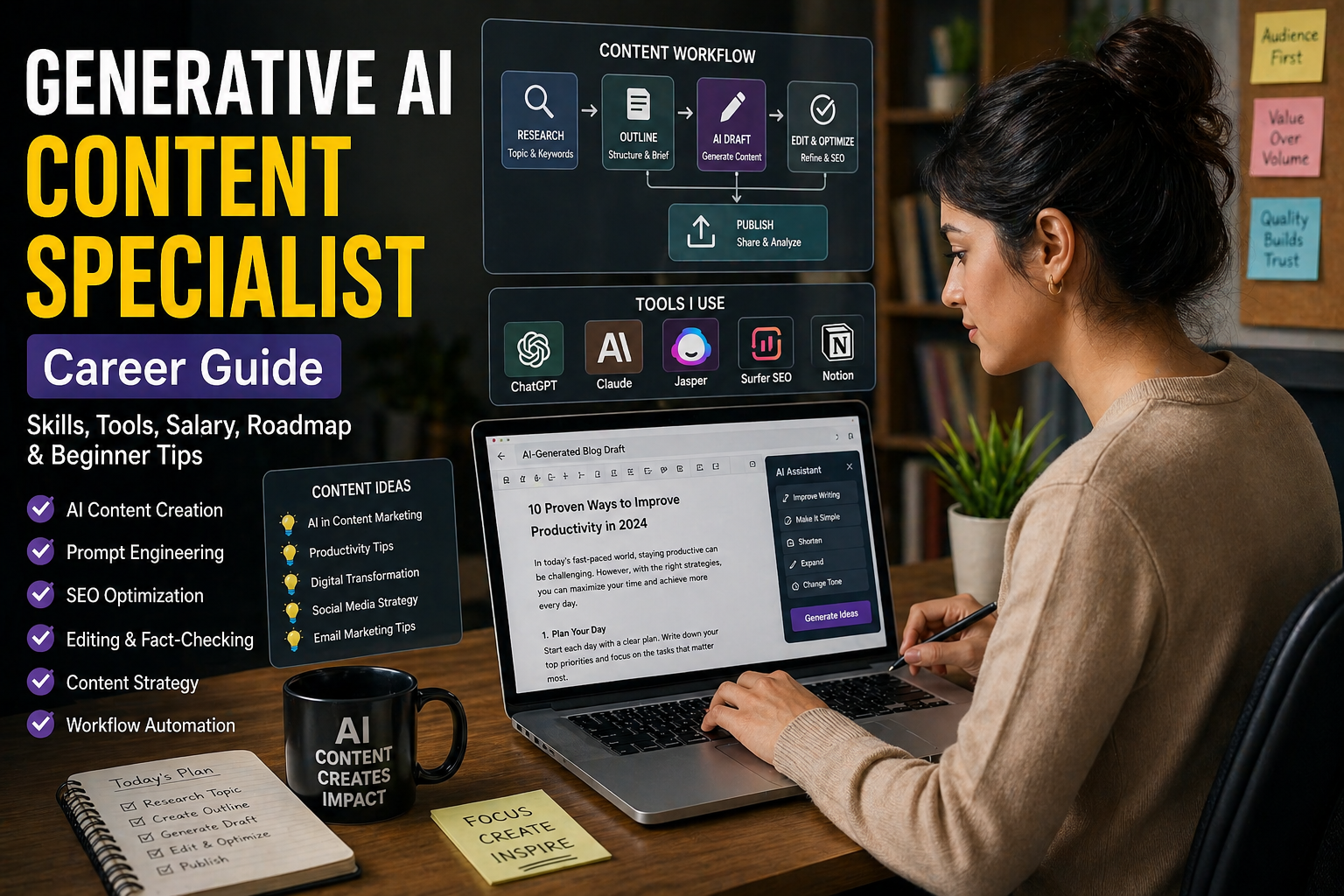
A Generative AI Content Specialist is a modern content professional who uses AI tools to plan, create, edit, improve, and organize content without sacrificing human judgment. Many beginners think this job is simply “asking AI to write articles.” That is a dangerous misunderstanding. In real professional work, the role is much more serious. You are not only generating text. You are shaping ideas, checking facts, improving clarity, protecting brand voice, understanding audiences, supporting SEO, and ensuring the final content is useful to real people.
If I were speaking as an older professional with decades of experience in media, marketing, publishing, and technology, I would tell you this first: content has never been only about words. Good content needs purpose. It must help, explain, sell, teach, guide, entertain, or build trust. AI can make content production faster, but speed without judgment creates low-quality work. A good Generative AI Content Specialist uses AI as an assistant, not as a replacement for thinking.
This career is good for people who enjoy writing, editing, research, SEO, digital marketing, creativity, and technology. It also requires responsibility. AI can make mistakes, invent facts, repeat generic ideas, or produce content that sounds good but says very little. Your job is to prevent that.
In this guide, I will answer 50 beginner questions about becoming a Generative AI Content Specialist in a realistic and human way. You will learn what the work actually looks like, what skills matter, what mistakes to avoid, and how to build a serious career in this fast-changing field.
50 Beginner Questions About Becoming a Generative AI Content Specialist
1. What does a Generative AI Content Specialist actually do?
A Generative AI Content Specialist uses AI tools to support the content creation process. That may include topic research, article outlines, blog drafts, social media captions, email newsletters, product descriptions, video scripts, SEO briefs, ad copy, and content repurposing. But the professional role is not just clicking a button and publishing whatever AI gives you.
The real work is planning, guiding, editing, checking, and improving. You need to understand the audience, the brand voice, the goal of the content, and the platform where it will appear. You also need to know when AI output is weak, generic, inaccurate, or risky.
In many companies, this role works with marketers, SEO specialists, editors, designers, product teams, and business owners. You may build prompts, create content workflows, review AI-generated drafts, and make sure final content is human, useful, and trustworthy. The value is not AI alone. The value is your judgment.
2. Is this job just writing prompts?
No, writing prompts are only one part of the job. Prompting helps you guide AI tools, but a Generative AI Content Specialist must understand content strategy, editing, SEO, brand tone, audience needs, accuracy, and publishing standards. If you only know prompts, your skill is too narrow.
A strong specialist knows how to turn a business goal into useful content. For example, if a company wants to attract customers through blog posts, you need to understand search intent, article structure, keyword use, internal linking, credibility, and conversion. AI can help draft, but it cannot automatically understand the full business context unless you guide it properly.
You also need to review and improve outputs. AI may write beautifully but still be shallow. Your job is to add clarity, examples, structure, facts, and originality. Prompting begins the process. Professional editing finishes it.
3. Isa Generative AI Content Specialist a real career?
Yes, it is a real career, but the title may change depending on the company. Some companies may call it AI Content Specialist, AI Content Editor, Content Automation Specialist, AI Copywriter, AI SEO Content Specialist, or Generative AI Strategist. The core skill is the same: using AI responsibly to create better content workflows.
The demand exists because businesses want more content, but they also need quality. AI can help with speed, but someone must control the process. Companies do not want random generic content. They want useful, accurate, branded content that serves customers and supports business goals.
However, you should not build your career only on tool usage. Tools change quickly. Build deeper skills: writing, editing, strategy, SEO, research, fact-checking, and audience understanding. Those skills make you valuable even when AI platforms change. The role is real when it creates real content value.
4. Do I need to be a good writer first?
Yes, writing skills help a lot. You do not need to be a famous author, but you must understand clarity, structure, tone, grammar, flow, and reader attention. AI can generate text, but if you cannot judge whether the text is good, you will publish weak content.
Good writing is not about using complicated words. It is about making ideas clear and useful. A beginner should learn how to write introductions, headings, explanations, conclusions, calls to action, and helpful examples. You should also learn how to remove unnecessary words.
AI often produces smooth but generic writing. A good writer can see that quickly. You can improve the content by adding real context, stronger examples, better structure, and more human rhythm.
If your writing is weak, do not worry. Practice daily. Editing AI content can actually help you learn, but only if you study why one version is better than another.
5. Do I need technical skills?
You do not need to be a programmer to start, but basic technical understanding helps. You should understand how AI tools work at a practical level, how prompts guide outputs, what tokens and context limits mean, and why AI can hallucinate. If you work with websites, SEO tools, CMS platforms, analytics, and automation, technical comfort becomes important.
For content work, you may need WordPress, Google Docs, Grammarly, Surfer SEO, Ahrefs, Semrush, Google Search Console, Canva, Notion, Airtable, or automation tools. You may also use AI platforms for text, image ideas, video scripts, and content repurposing.
Later, learning basic APIs, spreadsheets, and automation can make you much stronger. For example, you can build workflows for content briefs, metadata, article updates, and social posting. You do not need deep coding at first, but do not be afraid of technology. This role sits between content and tools.
6. What skills should a beginner learn first?
Start with writing and editing. Learn how to make content clear, organized, and helpful. Then learn basic SEO: search intent, keywords, headings, meta descriptions, internal links, and helpful content principles. After that, learn prompt writing and AI-assisted workflows.
You should also learn research and fact-checking. AI can produce false information, so you need to verify important claims. A content specialist who cannot check facts is risky for any company.
Next, learn brand voice. Every business speaks differently. A law firm, travel blog, fashion store, and software company should not sound the same. Your job is to adapt content to the audience.
Finally, learn content strategy. Ask why the content exists. Is it for traffic, education, sales, trust, support, or retention? Content without purpose becomes noise. Beginners who understand the purpose grow faster.
7. What is a typical day like in this job?
A typical day may include researching topics, creating content briefs, generating draft ideas with AI, editing articles, checking facts, optimizing headings, writing meta descriptions, preparing social posts, and reviewing analytics. You may also meet with marketing teams, SEO specialists, designers, or business owners.
Some days are creative. You brainstorm campaigns, article angles, video scripts, or newsletter ideas. Other days are more technical. You clean up old content, improve internal links, update outdated information, or build prompt templates.
A lot of the work is editing. Beginners imagine AI will write everything perfectly. In reality, professional content often needs human shaping. You may rewrite introductions, remove generic sections, add examples, correct claims, and make the article sound natural.
The job is fast-moving, but it still requires patience. Quality content is not just generated. It is developed.
8. What is the biggest mistake beginners make?
The biggest mistake is publishing AI content too quickly. Beginners often think that because AI can produce a full article in seconds, the work is finished. It is not. AI output must be reviewed, edited, checked, and improved before publishing.
Another mistake is creating generic content. AI tends to write safe, common, average explanations unless guided well. If your content says the same thing as hundreds of other websites, it will not build trust.
Beginners also ignore the audience. They focus on producing text instead of helping a real reader. Always ask: Who is this for? What question are they trying to answer? What would make this more useful than other articles?
A professional does not use AI to avoid thinking. A professional uses AI to speed up parts of the work while keeping responsibility for quality.
9. Can AI-written content rank on Google?
AI-assisted content can perform if it is helpful, original in value, accurate, and made for users. The problem is not AI by itself. The problem is low-quality, mass-produced, unhelpful content. If you publish thin articles that add no real value, you will struggle.
A Generative AI Content Specialist must understand that search engines reward usefulness, not just word count. You need good structure, clear answers, real insight, updated information, and a satisfying reader experience.
AI can help with outlines, drafts, FAQs, summaries, and optimization. But the final article should be reviewed by a person who understands the topic and audience.
For SEO, do not rely only on AI. Study search intent, competitors, keyword difficulty, internal linking, and user needs. AI can support SEO, but strategy and quality control remain human responsibilities.
10. Is this career good for SEO websites?
Yes, this career can be very useful for SEO websites, especially when used responsibly. AI can help create article outlines, topic clusters, meta descriptions, FAQs, content updates, title variations, and internal linking suggestions. It can also help repurpose long articles into social posts or newsletters.
But SEO websites need trust. If you publish too much generic AI content, readers may leave quickly, and the site may look low-quality. A good specialist focuses on useful articles, not just more articles.
For an AdSense-friendly site, quality matters. You need clear navigation, original explanations, helpful information, and safe content. Avoid fake expertise, unsupported claims, and repetitive filler.
AI can make your workflow faster, but your editorial standards must become stronger, not weaker. The best SEO content is made for readers first and optimized for search second.
11. How do I make AI content sound more human?
To make AI content sound more human, add real context, natural rhythm, specific examples, and honest limitations. AI often writes in a polished but empty way. Human writing feels more grounded. It explains what matters, what mistakes happen, and what the reader should actually do.
You should also vary sentence length. Remove repeated phrases. Replace generic statements with practical advice. For example, instead of saying “This career offers many opportunities,” explain what kind of opportunities and what skills create them.
A human tone does not mean being casual everywhere. It means sounding clear, thoughtful, and useful. Sometimes, professional writing should be calm and serious.
The best method is editing. Do not ask AI to “make it human” and stop there. Read the text yourself. Ask whether a real person would find it helpful. Then improve it.
12. What is brand voice?
Brand voice is the consistent style and personality of a business’s communication. Some brands sound formal and expert. Others sound friendly and simple. Some are bold and energetic. Others are calm and trustworthy.
A Generative AI Content Specialist must protect the brand voice when using AI. If every AI-generated article sounds the same, the brand loses identity. You need to define tone, vocabulary, sentence style, level of detail, and what the brand avoids.
For example, a medical clinic should not sound like a gaming blog. A luxury brand should not sound like a discount store. A financial company should be careful and precise.
You can create brand voice guidelines and prompt templates to help AI follow the right style. But you still need human review. Brand voice is not only about wording. It is trust.
13. What is content strategy?
Content strategy is the plan behind content. It answers why content is created, who it is for, what topics matter, what formats should be used, where it will be published, and how success will be measured.
Without a strategy, people produce random articles, posts, and videos without direction. AI can make this problem worse because it makes random content easier to create.
A good content strategy connects content to business goals. For example, a website may need educational blog posts to attract search traffic, comparison articles to help buyers decide, and email content to keep customers engaged.
A Generative AI Content Specialist should not only generate drafts. You should help organize content around goals. What topics build authority? What questions do customers ask? What content supports sales? Strategy makes AI output useful.
14. What is a content brief?
A content brief is a guide for creating a piece of content. It usually includes the topic, target audience, goal, keyword, search intent, headings, questions to answer, tone, internal links, sources, and special instructions.
Content briefs are very important when working with AI. If the brief is weak, the AI output will usually be weak. A clear brief gives direction and reduces generic writing.
For example, instead of asking AI to “write about a healthy breakfast,” a strong brief explains the audience, purpose, article angle, required sections, examples, and what claims to avoid.
A professional content specialist often spends more time on the brief than beginners expect. Good planning saves editing time. AI works better when the human gives it strong direction.
15. What is AI content editing?
AI content editing means reviewing and improving content generated or assisted by AI. This includes fixing grammar, improving structure, removing repetition, checking facts, adjusting tone, adding examples, and making the content more useful.
Editing is where your professional value becomes clear. Many people can generate a draft. Fewer people can turn that draft into publishable content.
AI content often has common problems: generic introductions, repeated ideas, vague advice, unsupported claims, and unnatural transitions. A good editor spots these quickly.
Editing also includes checking whether the content matches the brand and audience. A blog post for beginners should not sound like an academic paper. A product page should not sound like a neutral essay.
If you want this career, become a strong editor. AI can draft, but humans must judge.
16. What is fact-checking in AI content?
Fact-checking means verifying important claims before publishing. AI can invent statistics, misstate dates, confuse names, or present outdated information as current. This is called hallucination, and it is one of the biggest risks in AI content.
If your content includes health, finance, legal, technology, product, or news information, fact-checking becomes even more important. Wrong information can damage trust and create harm.
A good specialist checks claims using reliable sources. You should also avoid making exact claims when you cannot verify them. Use careful wording when information depends on location, date, or market.
Do not assume that confident writing means truth. AI can sound certain even when wrong. Your job is to protect readers and the brand from careless publishing.
17. What is AI hallucination?
AI hallucination happens when an AI tool creates false or unsupported information. It may invent a source, quote, statistic, product feature, person, company detail, or historical fact. The dangerous part is that the writing may sound very convincing.
A Generative AI Content Specialist must always remember this risk. You cannot blindly trust AI output, especially for factual topics.
To reduce hallucinations, give AI reliable context, ask it to avoid unsupported claims, require source-based writing when needed, and check important details yourself. For sensitive topics, human expert review may be necessary.
Hallucination does not mean AI is useless. It means AI must be handled responsibly. A calculator gives exact answers. A language model generates likely language. Those are not the same thing. Professionals understand the difference.
18. Can this job be done remotely?
Yes, many Generative AI Content Specialist jobs can be done remotely. Content planning, drafting, editing, SEO optimization, research, and publishing can all be managed online. Remote work is common in digital marketing, media, SaaS, e-commerce, agencies, and freelance content services.
But remote work requires discipline. You must meet deadlines, communicate clearly, document your process, and manage revisions professionally. If you work with a team, you may need to follow editorial calendars, content briefs, brand guidelines, and approval workflows.
Remote content work also requires trust. If you use AI, you should be transparent with your team or client about your workflow when needed. Never submit unchecked AI content as if it were fully researched expert work.
Remote work gives freedom, but it also demands responsibility. Your output must prove your professionalism.
19. Can this be a freelance career?
Yes, it can be a freelance career. Many businesses need help creating blog posts, newsletters, product descriptions, social media content, SEO briefs, video scripts, email campaigns, and AI content workflows. A freelancer who understands AI and content quality can offer practical services.
But do not sell “AI-generated articles” as your only service. That sounds cheap and replaceable. Sell outcomes: better content systems, faster editorial workflows, SEO content support, brand voice development, content updates, and high-quality AI-assisted drafts.
Freelancing requires communication, pricing, deadlines, revisions, and client management. You must define what is included. Does your service include research? SEO optimization? Images? Publishing? Revisions?
Start with clear packages. Build samples. Show before-and-after editing. Clients need proof that you improve content, not just generate text.
20. How much can a Generative AI Content Specialist earn?
Income depends on country, experience, niche, client type, language, and skill level. Beginners may start with modest pay, especially if they only produce basic content. Higher income usually comes when you combine AI skills with SEO, strategy, editing, marketing, analytics, or industry expertise.
A specialist who can create strong content workflows for businesses is more valuable than someone who only writes drafts. For example, if you help a company publish better content faster while keeping quality high, your work has business value.
Freelancers may charge per article, per project, monthly retainer, or by content system setup. Agencies may pay salaries based on skill and responsibility.
Do not believe exaggerated online claims that AI content work always makes easy money. Like any career, income follows value, trust, results, and professionalism.
21. What tools should I learn?
Start with AI writing tools and general productivity tools. Learn ChatGPT or similar AI assistants, Google Docs, WordPress, Grammarly, Notion, Canva, and basic spreadsheet tools. If you work in SEO, learn tools like Google Search Console, keyword research platforms, and content optimization tools.
You should also learn CMS workflows. Many content jobs involve uploading, formatting, adding headings, meta descriptions, images, categories, tags, and internal links.
For advanced work, learn automation tools like Zapier or Make. They can help you build systems for content calendars, AI briefs, publishing reminders, and repurposing.
But tools are not a career. Tools change quickly. Learn the principles: audience, structure, quality, accuracy, SEO, brand voice, and workflow. Once you understand those, new tools are easier to learn.
22. What is the difference between AI copywriting and AI content specialization?
AI copywriting usually focuses on persuasive writing, such as ads, landing pages, emails, product descriptions, and sales messages. The goal is often conversion: getting someone to click, buy, sign up, or respond.
A Generative AI Content Specialist may work more broadly. The role can include blog posts, SEO articles, newsletters, educational content, social media, video scripts, content briefs, editorial workflows, and AI content systems.
There is overlap. A content specialist may write copy, and a copywriter may use AI. But the specialist role often includes more strategy, editing, planning, workflow design, and quality control.
If you enjoy sales psychology, copywriting may be your focus. If you enjoy broader publishing systems, SEO, education, and editorial work, content specialization may fit better. Both require clear thinking and strong editing.
23. What is the role of SEO in this job?
SEO is very important if you create website content. You need to understand how people search, what questions they ask, and what kind of content satisfies their intent. AI can help create SEO content, but it can also create shallow content if used carelessly.
A Generative AI Content Specialist should know keywords, search intent, headings, meta titles, meta descriptions, internal links, image alt text, and content freshness. You should also understand that SEO is not keyword stuffing. Good SEO content answers the reader’s question better than competing pages.
AI can help brainstorm titles, outlines, FAQs, and related topics. But you must choose what is useful and accurate.
Strong SEO knowledge makes you more valuable because businesses often connect content directly to traffic, leads, and revenue.
24. What is search intent?
Search intent is the reason behind a search query. A person may want information, a product, a comparison, a tutorial, a local service, or a quick answer. If your content does not match the intent, it may not satisfy the reader.
For example, someone searching “best laptop for video editing” probably wants recommendations and comparisons. Someone searching “what is video editing” wants an explanation. These articles should be structured differently.
AI can write content, but it may miss intent unless you guide it. A beginner may create a long article that does not answer what the reader actually wants.
Before creating content, ask: What is the reader trying to do? Learn, buy, compare, fix, decide, or understand? Search intent should guide the whole article. This is one of the most important SEO skills.
25. Can AI help with social media content?
Yes, AI can help create captions, post ideas, content calendars, hooks, short scripts, carousel outlines, hashtags, and repurposed snippets from longer content. This can save a lot of time for social media teams.
But social media needs personality and timing. AI-generated posts can feel generic if you do not add brand voice, real opinions, current context, or audience understanding. A good specialist edits AI output so it feels native to the platform.
A LinkedIn post, TikTok script, Instagram caption, and X post should not sound the same. Each platform has its own style and user behavior.
AI is useful for drafts and variations. Human judgment decides what fits the brand, what feels natural, and what is worth posting. Social media rewards relevance, not just volume.
26. Can AI help with video scripts?
Yes, AI is very useful for video scripts, especially for YouTube, TikTok, Instagram Reels, tutorials, explainers, and educational content. It can help with hooks, outlines, scene ideas, talking points, titles, descriptions, and short-form repurposing.
But video scripts need rhythm. A script that reads well as an article may sound boring when spoken. You need to edit for natural speech, pacing, clarity, and visual flow.
A good Generative AI Content Specialist understands the difference between written content and spoken content. Video needs stronger openings, shorter sentences, and clear transitions. You should also think about visuals: what appears on screen while the words are spoken?
AI can speed up script development, but human editing makes it watchable. Good video content feels alive, not like a generated essay.
27. Can AI help with email marketing?
Yes, AI can help write email subject lines, newsletters, promotional emails, welcome sequences, abandoned cart emails, follow-ups, and customer education messages. It can also create variations for testing.
But email marketing needs trust. If your emails sound fake, exaggerated, or too frequent, people unsubscribe. AI should help you write clearer messages, not spam people faster.
A good specialist understands the audience stage. A new subscriber needs a different message than a loyal customer. A cold lead needs different wording than someone who has already purchased.
You should also know basic email structure: subject line, preview text, opening, value, call to action, and clean formatting.
AI can generate options quickly. Your job is to choose, edit, and align the message with the reader’s needs and the brand’s reputation.
28. Can AI help with product descriptions?
Yes, AI can help create product descriptions, feature lists, benefit-focused copy, category descriptions, comparison text, and marketplace listings. This is especially useful for e-commerce stores with many products.
But product descriptions must be accurate. AI should not invent features, materials, sizes, guarantees, or benefits. You need reliable product data first. If the input is weak, the output may be wrong.
A good product description explains what the product is, who it is for, what problem it solves, and what details matter before purchase. It should be clear, not overhyped.
For SEO, product descriptions should be unique and helpful. Copying manufacturer text or publishing generic AI descriptions can make a store look low-quality.
AI can save time, but accuracy and trust matter more than speed.
29. What is content repurposing?
Content repurposing means turning one piece of content into multiple formats. For example, a blog article can become social media posts, a newsletter, a video script, short quotes, infographic points, or FAQ content.
AI is very helpful for repurposing because it can summarize, restructure, and adapt tone quickly. But you must adjust the content for each platform. A long paragraph should not be copied directly into a social post.
A Generative AI Content Specialist can build repurposing workflows that save time. For example, after publishing an article, AI can help create five social posts, one email newsletter, and three short video ideas.
This is valuable because businesses often underuse their content. Repurposing helps one good idea reach more people without starting from zero every time.
30. What is an editorial workflow?
An editorial workflow is the process that content goes through from idea to publication. It may include topic research, brief creation, drafting, editing, fact-checking, SEO optimization, image selection, approval, publishing, and performance review.
AI can support many parts of this workflow, but it should not remove quality control. A strong workflow makes sure content is not published too quickly or carelessly.
For example, AI may create the first outline, a writer may draft, an editor may review, a specialist may optimize SEO, and a manager may approve. In small teams, one person may do several steps.
A professional Generative AI Content Specialist understands workflow. You are not only making content. You are helping build a system that produces content consistently and responsibly.
31. How do you avoid generic AI content?
To avoid generic AI content, give AI specific context, audience details, examples, brand voice, and a clear angle. Do not ask broad questions like “write a fitness article.” Instead, define who the reader is, what problem they have, what tone is needed, and what practical details should be included.
After generation, edit heavily. Remove vague lines. Add real examples. Include specific steps, warnings, comparisons, and lived experience where appropriate. Make sure each section teaches something.
Generic content often uses phrases like “in today’s fast-paced world” or repeats obvious advice. Cut those parts.
The best way to avoid generic content is to know the topic and audience better. AI can help with language, but human insight creates originality. Specificity is what makes content feel real.
32. How important is research?
Research is very important. AI can help organize ideas, but it should not replace real research. If you publish content without checking facts, you risk misleading readers and damaging the brand.
Research may include reading reliable sources, studying competitors, checking product information, reviewing customer questions, analyzing search results, and interviewing subject matter experts.
For simple lifestyle topics, research may be light. For finance, health, legal, technology, or current topics, research must be stronger.
A Generative AI Content Specialist should know when a claim needs verification. Do not let AI invent authority. If you do not know something, check it.
Good research gives your content depth. Without research, AI-assisted content often becomes polished but empty.
33. How do you work with subject matter experts?
Subject matter experts are people who deeply understand a topic, such as doctors, lawyers, engineers, financial advisors, mechanics, or experienced business professionals. Working with them improves content quality and trust.
AI can help prepare questions, summarize interviews, and turn expert notes into articles. But the expert provides real knowledge that AI cannot replace.
When working with experts, be respectful of their time. Prepare clear questions. Ask for practical examples, common mistakes, and important warnings. Then turn their answers into reader-friendly content.
This is especially important for sensitive or technical topics. A content specialist should not pretend to be an expert in everything. Your skill is translating expertise into clear content.
Expert input can make AI-assisted content much stronger and more trustworthy.
34. What is the role of editing in this career?
Editing is one of the most important parts of the job. AI can produce a draft, but editing turns it into useful content. Editing improves structure, removes repetition, checks accuracy, strengthens examples, adjusts tone, and makes the content easier to read.
Many beginners underestimate editing. They think generating is the main work. In professional content, editing often takes more skill than drafting.
A good editor asks: Is this clear? Is it useful? Is it accurate? Is it too generic? Does it match the audience? Does each section add value? Is anything missing?
If you become a strong AI content editor, you will be valuable. Businesses do not just need more words. They need better content. Editing is where better content is made.
35. What should I include in a portfolio?
Your portfolio should show different types of AI-assisted content work. Include blog articles, SEO briefs, edited AI drafts, social media examples, email sequences, product descriptions, video scripts, and content strategy samples.
Most importantly, show process. Do not only show the final content. Show the original task, the prompt or brief, the AI draft, your edits, and the final improved version. This proves you are not just copying AI output.
You can create sample projects if you do not have clients yet. Choose a niche like travel, technology, jobs, fitness, e-commerce, or finance education. Build a mini content campaign.
Make your portfolio clean and easy to review. A client or employer should quickly understand what you can do and how you improve content quality.
36. How do I get my first job or client?
Start by creating samples. Pick a niche and produce a small portfolio: one SEO article, one content brief, one newsletter, one social media calendar, and one before-and-after AI editing example. Then approach small businesses, agencies, bloggers, e-commerce stores, or website owners.
When you speak to clients, do not only say “I use AI.” Say what result you can help with: faster content production, better article structure, SEO-friendly briefs, improved product descriptions, or consistent brand voice.
Your first client may come from a small project. Offer a clear service with defined deliverables. For example: “I will create four SEO article briefs and AI-assisted drafts with human editing.”
Do not overpromise. Deliver quality, communicate well, and ask for feedback. One good client can lead to referrals.
37. Should I specialize in a niche?
Yes, specialization can help you stand out. A general AI content specialist competes with many people. A specialist in finance content, healthcare content, SaaS content, e-commerce content, travel content, legal marketing, or SEO blog systems is easier to understand and trust.
Specialization helps you learn audience needs, common questions, industry language, and content standards. Your prompts and workflows become better because you understand the field.
However, beginners can start broadly while exploring. After you work on several topics, notice which ones you enjoy and where you produce the best results.
A niche does not trap you forever. It gives you a stronger market position. Clients often prefer someone who understands their type of content instead of someone who claims to write everything.
38. What niches are good for this career?
Good niches include technology, AI tools, SaaS, digital marketing, e-commerce, career advice, finance education, real estate, health and wellness, travel, online education, business operations, and product content. These niches need regular content and often benefit from AI-assisted workflows.
But some niches require extra caution. Health, legal, finance, and medical content need careful fact-checking and sometimes expert review. Do not publish strong claims without proper support.
Choose a niche based on interest, market demand, and your ability to learn. If you already know websites and SEO, career guides or digital marketing content may fit. If you understand e-commerce, product descriptions, and category content may be good.
The best niche is where you can create useful content repeatedly and understand the reader’s real problems.
39. Can this job help with AdSense websites?
Yes, this job can help AdSense websites if the focus is on quality, originality, and user value. AI can help plan article topics, create outlines, write drafts, generate FAQs, improve readability, and update old content. But AdSense approval and long-term success depend on trust and usefulness.
Avoid thin content, copied content, fake authority, and mass-generated low-value articles. A good website needs clear categories, helpful posts, important pages, good navigation, and content that answers real questions.
A Generative AI Content Specialist can create a publishing workflow that supports quality: topic research, brief creation, draft generation, human editing, fact-checking, SEO optimization, and final review.
AI can help you publish faster, but it should not lower standards. For AdSense-style sites, human review is very important.
40. What are the risks of this career?
The main risk is becoming too dependent on AI tools and not building your own judgment. If all you can do is generate text, you are easy to replace. You need editing, strategy, SEO, research, and brand understanding.
Another risk is a low-quality reputation. If you publish generic or inaccurate content, clients may lose trust. Content quality is visible. Readers can feel when an article is empty.
There is also a tool risk. AI platforms change pricing, features, and output style. If your workflow depends on one tool only, you may struggle when it changes.
The solution is to build durable skills. Learn how content works, how readers think, and how businesses use content. AI is your tool. Your judgment is your career.
41. How do I use AI ethically in content?
Use AI ethically by being accurate, honest, respectful, and careful. Do not use AI to create fake quotes, fake reviews, fake expertise, false claims, or misleading information. Do not copy copyrighted material. Do not present unverified information as fact.
Respect privacy. Do not paste sensitive client data into tools without permission or understanding the tool’s data policy. Be careful with customer information, private documents, and internal business data.
Also, do not use AI to flood the internet with useless content. Publishing low-value content wastes readers’ time and damages trust.
Ethical AI content work means using technology to help people understand, decide, learn, or solve problems. If the content does not help the reader, ask why it should exist.
42. How do you handle AI-generated images or visuals?
AI-generated visuals can help with featured images, social media graphics, blog illustrations, and concept art. But you need to use them carefully. The image should match the content, brand, and audience. It should not mislead people or show false real-world evidence.
For article featured images, make sure the design is clean, readable, and relevant. Avoid cluttered images with too much text. If text is included in the image, check spelling carefully because AI image tools can make mistakes.
Also, think about originality and licensing. Use tools and assets according to their terms.
A Generative AI Content Specialist does not always need to create visuals, but understanding image prompts and visual direction is useful. Content is not only text. Presentation affects trust and clicks.
43. How do you measure success in this job?
Success depends on the goal. For SEO content, you may measure rankings, organic traffic, impressions, clicks, time on page, and conversions. For email, you may measure open rates, click rates, replies, and sales. For social media, you may measure engagement, reach, shares, and follower growth.
But numbers are not everything. Content quality, brand consistency, accuracy, and usefulness matter too. A page may get traffic but fail to help readers. That is not real success.
A professional asks before creating content: What should this content achieve? Education? Leads? Sales? Trust? Support? Retention?
AI can help produce more, but success should be measured better, not only faster. The best content systems balance quantity, quality, and business impact.
44. What is the future of this career?
The future of this career will likely become more professional. Basic AI content generation will become common, and many people will know how to use AI tools. That means simple “AI writer” work may become less valuable.
The stronger future is in strategy, editing, quality control, brand voice, SEO systems, content operations, and AI workflow design. Companies will need people who can manage AI-assisted content responsibly.
There will also be more demand for human judgment. As AI content becomes everywhere, readers will value content that feels useful, specific, accurate, and trustworthy.
If you want to stay valuable, do not stop at generating drafts. Learn how to build content systems, improve quality, and connect content to business goals. That is where the career becomes stronger.
45. Will AI replace content writers?
AI will replace some low-level content tasks, especially repetitive, generic writing. But it will not replace all content professionals. Writers and content specialists who can think strategically, edit deeply, understand audiences, and produce original value will still matter.
The role is changing. Instead of writing every sentence from zero, many professionals will guide AI, edit outputs, add expertise, and manage workflows. This can make good content teams faster.
The people most at risk are those who only produce generic content without insight. The people who adapt will use AI as a tool.
A beginner should not fear AI. Learn to work with it. But also build human skills AI does not fully replace: judgment, taste, empathy, research, ethics, and real experience.
46. What should I avoid when using AI for content?
Avoid publishing without review. Avoid fake facts, fake quotes, fake statistics, and fake experience. Avoid copying AI output directly when it is generic or repetitive. Avoid keyword stuffing. Avoid making medical, legal, or financial claims without proper review.
Also, avoid using the same prompt for every topic. Different topics need different angles, audiences, and structures. If all your articles look the same, readers will notice.
Avoid chasing word count over usefulness. A 2,000-word article that repeats itself is weaker than a 1,000-word article that clearly solves the reader’s problem.
Most of all, avoid thinking AI removes responsibility. If you publish it, you are responsible for it. Review carefully.
47. What first project should a beginner build?
A good first project is an AI-assisted content package for one niche website. Choose a topic, such as career advice, healthy living, travel tips, or e-commerce. Create a content strategy with 10 article ideas, then write one full article using a proper workflow.
Your project should include keyword research, search intent, content brief, AI-assisted outline, draft, human editing, meta title, meta description, FAQs, and social media repurposing.
Show the process in your portfolio. Explain what AI helped with and what you improved manually. This demonstrates professional thinking.
Do not start with 100 articles. Start with one excellent example. Quality samples help more than mass output. A strong first project can teach you the whole workflow from idea to publication.
48. How can I stand out from other beginners?
Stand out by showing quality control. Many beginners can generate content. Fewer can prove they can improve it. Show before-and-after examples. Explain your editing decisions. Demonstrate fact-checking. Show SEO structure and brand voice adaptation.
Also, to build niche knowledge. If you understand a specific industry, your content becomes more useful. Generic AI content is everywhere. Specific, reader-focused content is harder to find.
Learn content analytics. If you can look at traffic, clicks, rankings, or engagement and suggest improvements, you become more valuable.
Finally, communicate professionally. Meet deadlines, follow briefs, ask smart questions, and accept feedback. Reliability is a major advantage. Many clients prefer a dependable specialist over a flashy one.
49. How long does it take to become good?
You can learn basic AI content workflows in a few weeks, but becoming good takes months or years of practice. Writing, editing, SEO, research, and strategy all improve with repetition.
If you already have writing or marketing experience, you may progress faster. If you are new to content, start with fundamentals. Learn what makes an article useful, how headings work, how readers scan pages, and how SEO supports content.
Do not measure progress only by how fast you can generate text. Measure it by how much better your final content becomes. Can you remove fluff? Can you improve clarity? Can you match search intent? Can you avoid false claims?
Skill grows through careful practice. Create, review, improve, publish, measure, and repeat.
50. What final advice would you give to someone serious about this career?
Take the role seriously. Generative AI content work is not about producing endless text. It is about helping businesses communicate better, teach better, sell more honestly, and serve readers more effectively.
Build strong foundations. Learn writing, editing, SEO, research, brand voice, and content strategy. Then use AI to speed up and improve your workflow. Do not let AI become a substitute for your own thinking.
Be honest about what AI can and cannot do. It can help with drafts, ideas, summaries, and structure. It cannot guarantee truth, taste, or real expertise. That is where you come in.
Create a portfolio that shows your process. Show that you can guide AI, improve weak drafts, fact-check claims, and produce useful final content.
The future will reward people who combine human judgment with AI speed. If you become one of those people, you can build a strong and flexible career.
ConclusioA n
Generative AI Content Specialist is a strong career path for people who enjoy content, technology, creativity, and practical communication. It is especially good for writers, editors, marketers, SEO specialists, bloggers, social media managers, and digital entrepreneurs who want to use AI without sacrificing quality.
This job is good for people who like improving ideas, organizing information, understanding audiences, and creating useful content. If you enjoy writing but also like tools, workflows, and strategy, this role can fit you well. It can also be a good freelance path because many businesses need content but do not know how to use AI properly.
However, this career is not good for people who want to generate quick articles without thinking. That approach may produce low-quality content, damage trust, and create problems for websites. AI can make work faster, but it also makes it easier to make mistakes. A serious specialist must care about accuracy, originality, tone, and reader value.
A beginner should start with the basics. Learn writing and editing first. Then learn SEO, content briefs, prompt writing, fact-checking, and brand voice. Practice by creating a small portfolio. Show not only the final article, but also your process: the brief, the AI draft, your edits, and the final improved version.
As you grow, learn content strategy and analytics. Understand what content does for a business. Does it bring traffic? Build trust? Help customers? Support sales? Reduce support questions? When you understand the purpose, your work becomes more valuable.
The future of content will not be humans versus AI. It will be humans using AI wisely. Generic content will become common, but useful, accurate, well-edited, human-guided content will still stand out. If you build judgment, taste, research habits, and technical comfort, you can become a valuable Generative AI Content Specialist.
FAQs
1. What does a Generative AI Content Specialist do?
A Generative AI Content Specialist uses AI tools to help plan, draft, edit, optimize, and manage content while maintaining quality, accuracy, brand voice, and usefulness for readers.
2. Do I need to be a writer to become a Generative AI Content Specialist?
Strong writing and editing skills are very helpful. AI can generate drafts, but you need human judgment to improve clarity, accuracy, tone, and structure.
3. Can AI-generated content rank on Google?
AI-assisted content can perform if it is helpful, accurate, original in value, and created for users. Low-quality mass-generated content is risky and often performs poorly.
4. What tools should beginners learn?
Beginners should learn AI writing tools, Google Docs, WordPress, Grammarly, Canva, basic SEO tools, keyword research tools, and content planning platforms like Notion or Airtable.
5. How do I start this career?
Start by learning writing, editing, SEO, prompt design, and fact-checking. Build a portfolio with AI-assisted articles, briefs, social posts, emails, and before-and-after editing examples.