Table of Contents
Introduction
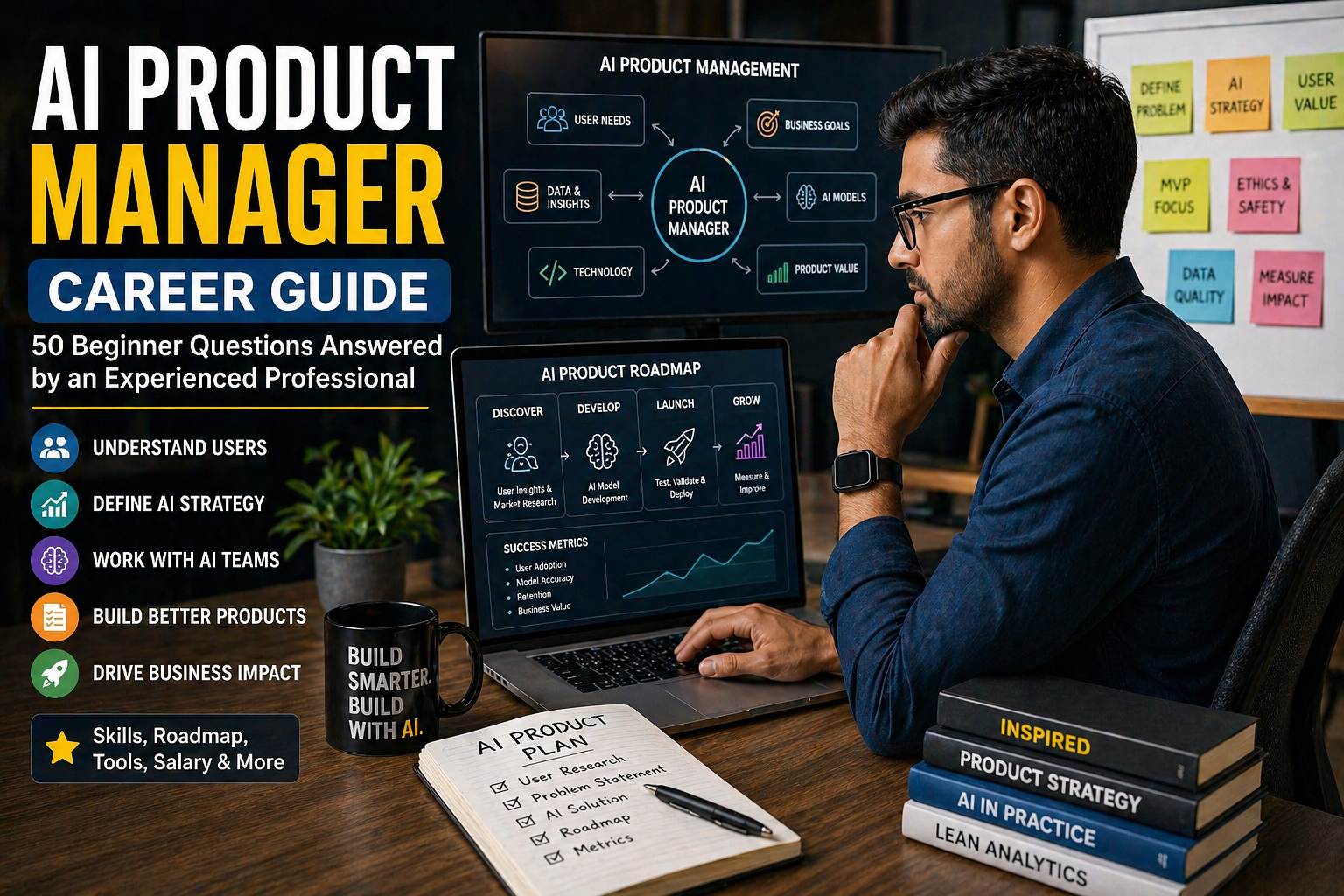
An AI Product Manager is the person who helps turn artificial intelligence from an interesting technology into a useful product that real people can use. Many beginners think this job is about having big ideas and telling engineers to “add AI.” In reality, the work is much more careful. AI Product Managers must understand users, business goals, technical limits, data quality, model behavior, risk, cost, and product experience.
If I were speaking to you as a 50–60-year-old professional with decades of experience in technology and product work, I would tell you this first: AI does not automatically make a product better. Sometimes AI improves speed, personalization, automation, or decision-making. Other times, it adds confusion, cost, risk, and poor user experience. A good AI Product Manager knows the difference.
This role sits between many teams. You work with engineers, machine learning specialists, designers, data scientists, marketers, legal teams, executives, customer support, and users. You must translate business needs into product requirements and technical realities into simple explanations. You are not expected to be the best coder in the room, but you must understand enough to ask the right questions.
AI Product Management is a strong career for people who enjoy strategy, communication, problem-solving, technology, and responsibility. It is not for people who only chase trends. In this guide, I will answer 50 beginner questions about the real work, skills, mistakes, stress, tools, career growth, and future of AI Product Managers.
50 Beginner Questions About Becoming an AI Product Manager
1. What does an AI Product Manager actually do?
An AI Product Manager guides the development of products that use artificial intelligence. The job is to understand user problems, define product goals, work with technical teams, prioritize features, test results, manage risks, and make sure the AI actually creates value. You are not just adding AI because it sounds modern. You are asking whether AI is the right solution for a real user need.
In daily work, you may write product requirements, review model performance, speak with customers, analyze feedback, plan roadmaps, coordinate engineers and designers, and explain trade-offs to leadership. You also need to think about safety, privacy, accuracy, cost, and user trust.
A good AI Product Manager does not need to build the model personally, but they must understand how AI behaves. AI products are less predictable than normal software. That means your job includes managing uncertainty. You help the team build something useful, responsible, and realistic.
2. How is an AI Product Manager different from a regular Product Manager?
A regular Product Manager focuses on users, business goals, product strategy, features, and team coordination. An AI Product Manager does all of that, but also deals with AI-specific challenges. These include model accuracy, data quality, hallucinations, bias, privacy, explainability, evaluation, model costs, and uncertainty.
In normal software, if you press a button, you expect the same result every time. In AI products, the output can vary. The system may be correct most of the time, but still fail in important cases. That changes how you design, test, launch, and support the product.
An AI Product Manager must ask different questions. What data trains or supports the system? What happens when the model is wrong? Should a human review the output? How do we measure quality? How do we explain AI decisions to users?
So the foundation is product management, but the risks and details are more complex.
3. Do I need to be technical to become an AI Product Manager?
You do not need to be a machine learning engineer, but you must be technically literate. That means you should understand the basics of AI models, data pipelines, APIs, evaluation metrics, model limitations, and product architecture. You need enough technical understanding to have serious conversations with engineers and data scientists.
If you cannot understand basic AI concepts, you may make unrealistic promises or write weak requirements. Engineers will quickly notice when a Product Manager does not understand the work. But you do not need to code everything yourself.
The best AI Product Managers are translators. They understand business language, user language, and technical language. They can speak with executives in simple terms, then discuss trade-offs with engineers.
Start by learning the basics: machine learning, large language models, data quality, AI hallucinations, prompt design, and model evaluation. Technical curiosity matters more than pretending to know everything.
4. What skills should a beginner learn first?
Start with classic product management skills: user research, problem definition, product strategy, roadmaps, prioritization, writing requirements, and measuring success. Without these, you cannot manage any product well, AI or not.
Then learn AI fundamentals. Understand how machine learning works at a high level, what large language models can and cannot do, how data affects output quality, and why AI systems need testing. You should also learn about privacy, bias, safety, and responsible AI.
Communication is another key skill. You must explain complicated things clearly. You will often speak with people who have very different backgrounds: engineers, designers, executives, legal teams, and customers.
Finally, learn analytics. Product decisions should not be based only on opinions. Understand user behavior, adoption, retention, conversion, satisfaction, and quality metrics. AI Product Managers must combine product sense with evidence.
5. What is a typical day like for an AI Product Manager?
A typical day may include meetings with engineers, reviewing product metrics, reading customer feedback, writing product requirements, checking AI output quality, planning experiments, and discussing launch risks. You may also speak with legal or compliance teams if the product handles sensitive data.
Some days are strategic. You decide which AI feature should be built next and why. Other days are practical. You may review examples where the AI gave poor results and help the team decide how to fix the issue.
You spend a lot of time asking questions. What problem are we solving? What does success look like? Is the data good enough? What happens when the AI fails? Will users trust this feature?
The job is not only about creative brainstorming. It is coordination, decision-making, and responsibility. You help the team move forward without ignoring real risks.
6. Is AI Product Management a good career?
Yes, it can be a strong career, especially as more companies add AI features to software, services, and internal tools. Businesses need people who can connect AI technology with real customer needs. That is exactly where an AI Product Manager can provide value.
But it is not an easy shortcut. You need product judgment, technical understanding, communication skills, and the ability to manage uncertainty. AI products can fail in unusual ways, and you must be ready for that.
This career is good for people who like working with teams, solving business problems, and learning new technology. It is not ideal for someone who wants to work alone all day or avoid responsibility.
The opportunity is real, but the expectations are also high. Companies do not need someone who only says “AI is the future.” They need someone who can decide where AI truly helps.
7. What is the hardest part of being an AI Product Manager?
The hardest part is managing uncertainty. In traditional products, features usually behave predictably. In AI products, the output may vary depending on data, prompts, user behavior, model changes, and context. This makes planning and quality control more difficult.
Another hard part is expectation management. Executives may expect AI to solve everything quickly. Users may expect perfect answers. Engineers may warn that the model is not ready. You stand in the middle and must keep everyone realistic.
You also need to balance innovation and risk. If you move too slowly, competitors may pass you. If you move too fast, you may launch something unreliable or harmful.
A mature AI Product Manager is calm. They do not get blinded by hype. They ask hard questions, test carefully, and make decisions based on evidence.
8. Do AI Product Managers need to understand machine learning?
Yes, at least at a practical level. You do not need to derive formulas or train complex models yourself, but you should understand supervised learning, unsupervised learning, model training, evaluation, overfitting, data quality, and model drift.
You need this knowledge because product decisions depend on technical reality. For example, if the model needs labeled data and the company does not have it, that affects the timeline and cost. If the model’s accuracy is not high enough, that affects user trust.
Understanding machine learning also helps you ask better questions. What data was used? How was performance measured? Where does the model fail? How often should it be retrained?
A Product Manager who understands these basics earns more trust from technical teams. You do not need to be an expert, but you must be informed enough to lead responsibly.
9. What are large language models, and why should AI Product Managers care?
Large language models are AI systems that can understand and generate text. They are used for chatbots, writing assistants, summarization, search, coding help, document analysis, customer support, and many other product features.
AI Product Managers should care because many modern AI products are built around language. Users want systems that answer questions, explain things, draft content, analyze documents, and automate communication. Large language models make these features possible.
But they also create risks. They can hallucinate, misunderstand context, produce biased responses, or give answers that sound confident but are wrong. Product Managers must design around these limitations.
You should understand what these models are good at and where they are weak. They are powerful for language tasks, but they are not perfect truth machines. Product success depends on using them in the right way.
10. What is the role of data in AI products?
Data is one of the most important parts of an AI product. AI systems depend on data for training, personalization, retrieval, evaluation, and improvement. Poor data leads to poor results. Good data can make even a simpler model useful.
As an AI Product Manager, you must understand what data is available, where it comes from, whether it is clean, whether it can legally be used, and whether it represents real user needs. You do not need to clean every dataset yourself, but you must ask the right questions.
Data also affects product trust. If users provide private information, the product must protect it. If the data is biased, the product may behave unfairly.
A beginner should never treat data as a technical detail only. Data is a product issue, a business issue, and a trust issue. Good AI products begin with responsible data thinking.
11. What is an AI product roadmap?
An AI product roadmap is a plan that shows what AI features or improvements the team intends to build over time. It connects user problems, business goals, technical feasibility, and risk. A roadmap is not just a list of exciting AI ideas.
For example, a roadmap may include improving search relevance, adding document summarization, launching a chatbot, building human review tools, improving evaluation, reducing model cost, or adding safety controls.
AI roadmaps must be flexible because AI work involves uncertainty. A feature may take longer if data quality is poor or model performance is weak. You should avoid promising exact outcomes too early.
A good roadmap balances quick wins and long-term infrastructure. Sometimes the best roadmap item is not a flashy feature but better data collection, evaluation tools, or monitoring. These foundations make future AI features stronger.
12. How do AI Product Managers decide what to build?
They start with user problems, not technology. A weak Product Manager says, “Let’s add AI because everyone is doing it.” A strong Product Manager asks, “What problem are users struggling with, and can AI solve it better than other options?”
You look at customer feedback, support tickets, analytics, market trends, business goals, and technical feasibility. Then you prioritize based on value, effort, risk, and strategic importance.
For AI products, you also consider data readiness, model performance, cost, safety, and user trust. A feature may sound useful, but be too risky or expensive right now.
The best AI Product Managers are disciplined. They do not chase every idea. They choose features that solve meaningful problems and can be delivered responsibly. Product management is often the art of saying no to attractive distractions.
13. What is user research in AI Product Management?
User research means understanding users’ needs, frustrations, behaviors, and expectations. For AI products, this is especially important because users may not understand what AI can and cannot do. You need to learn what they truly need, not only what they say they want.
Research may include interviews, surveys, usability tests, support ticket analysis, customer calls, and product analytics. You may ask users how they currently solve a problem, where they waste time, and what kind of AI help they would trust.
AI features can easily become impressive but unnecessary. User research protects you from building technology that nobody needs.
You should also research user trust. Would users accept AI suggestions? Do they need explanations? Do they want human approval? These questions shape the product experience. Good AI products are built around real people, not only models.
14. How important is UX design in AI products?
UX design is extremely important in AI products. AI features can confuse users if the experience is not clear. Users need to know what the AI can do, what it cannot do, and how much they should trust the output.
For example, if an AI tool summarizes a legal document, the interface should make it clear that the summary is assistance, not final legal advice. If an AI writes an email draft, users should be able to edit it before sending.
Good UX also includes feedback loops. Users should be able to correct AI outputs, rate answers, report problems, or ask for changes. This helps improve the product.
AI is not only a backend feature. The way users interact with it determines whether they trust it. A strong AI Product Manager works closely with designers to make AI understandable, useful, and safe.
15. What is AI hallucination, and why does it matter for Product Managers?
AI hallucination happens when an AI system produces information that sounds confident but is false or unsupported. This matters greatly because product users may trust the answer, especially if it is presented professionally.
For Product Managers, hallucination is not just a technical issue. It is a user trust issue, brand issue, legal issue, and safety issue. If an AI assistant gives wrong financial, medical, legal, or business information, the consequences can be serious.
You reduce hallucination through better prompts, retrieval from trusted sources, clear limitations, citations, evaluation, human review, and careful product design. In some cases, the product should refuse to answer instead of guessing.
A beginner Product Manager must understand this deeply: AI output quality is part of the product. You cannot ignore it and say, “That is the model’s fault.” The product team owns the user experience.
16. What is retrieval-augmented generation?
Retrieval-augmented generation, often called RAG, is a method where an AI system retrieves relevant information from trusted documents or databases before generating an answer. This helps the AI respond based on specific information instead of only general model knowledge.
For example, a company chatbot may search internal help articles before answering a customer. The model uses those retrieved documents as context.
AI Product Managers should understand RAG because many business AI products need answers based on company data. Users do not want general guesses. They want answers from policy documents, product manuals, contracts, knowledge bases, or support articles.
RAG can reduce hallucinations, but it is not perfect. The search quality, document structure, and answer design all matter. Product Managers must ask whether the system retrieves the right information and whether users can verify the answer. RAG is a product feature, not just a technical method.
17. What is model evaluation?
Model evaluation means checking how well an AI model or AI feature performs. For Product Managers, evaluation is essential because you need evidence before launch. You cannot rely only on impressive demos.
Evaluation may include accuracy, relevance, helpfulness, safety, response quality, latency, cost, user satisfaction, and business impact. For language models, evaluation can be more complex because answers may be partly correct, incomplete, or poorly worded.
A good AI Product Manager works with technical teams to define what “good” means. For a support chatbot, success may mean correct answers, reduced ticket volume, and high customer satisfaction. For a writing assistant, success may mean useful drafts and lower editing time.
Evaluation connects AI performance to product value. Without evaluation, you are guessing. Good product decisions need measurement.
18. What metrics should an AI Product Manager track?
You should track both product metrics and AI quality metrics. Product metrics may include adoption, retention, conversion, engagement, task completion rate, customer satisfaction, churn, revenue impact, and support volume. AI quality metrics may include accuracy, relevance, hallucination rate, response time, user correction rate, escalation rate, and cost per request.
The right metrics depend on the product. For an AI support assistant, you may track the resolution rate and incorrect answer reports. For an AI writing tool, you may track how often users accept or edit suggestions.
Be careful with vanity metrics. A feature may get many clicks because it is new, but that does not mean it is useful. Look for repeat usage and real outcomes.
A mature AI Product Manager chooses metrics before launch. That way, the team knows whether the feature is actually working.
19. What is human-in-the-loop design?
Human-in-the-loop design means a person reviews, approves, or corrects the AI output before it affects the real world. This is very important in AI products where mistakes can be costly or harmful.
For example, AI may draft a customer email, but a human support agent approves it before sending. AI may suggest a medical note summary, but a healthcare professional reviews it. AI may flag suspicious transactions, but a fraud analyst makes the final decision.
Human review can make AI products safer and more trusted. It also creates feedback that can improve the system over time.
Product Managers must decide where human review is needed. Full automation is not always the best product. Sometimes the best experience is AI assistance plus human judgment. Responsible product design means knowing the difference.
20. What is the role of ethics in AI Product Management?
Ethics is central to AI Product Management because AI products can affect decisions, information, privacy, opportunities, and trust. A Product Manager must think about fairness, transparency, safety, consent, bias, and accountability.
For example, if an AI system helps screen job candidates, you must consider whether it treats people fairly. If an AI product uses customer data, you must consider privacy. If it gives recommendations, you must consider whether users understand how much to trust them.
Ethics is not only a legal department’s job. Product decisions shape how AI affects users. What you build, what you measure, what you hide, and what you allow all matter.
A responsible AI Product Manager asks hard questions early. Could this harm someone? Could it mislead users? Are we using data fairly? These questions protect both users and the business.
21. How do AI Product Managers work with engineers?
AI Product Managers work closely with engineers to define what needs to be built, why it matters, and what constraints exist. Engineers understand the technical implementation. Product Managers understand user needs, business goals, and priorities. The best work happens when both sides respect each other.
You should not dictate technical solutions without listening. Instead, explain the problem clearly and discuss options. Ask engineers about feasibility, trade-offs, risks, timelines, and system limitations.
For AI products, engineers may warn you about latency, model cost, data quality, or reliability. Listen carefully. These are not excuses; they are real product issues.
A good Product Manager protects engineers from vague requirements and protects users from poorly designed features. Clear communication, good documentation, and mutual respect are essential.
22. How do AI Product Managers work with data scientists?
Data scientists help analyze data, build models, evaluate performance, and find patterns. AI Product Managers work with them to connect model work to product goals. You should explain the user problem and business objective, while data scientists explain what the data can support.
This relationship is important because not every business question can be answered with available data. A data scientist may say the dataset is too small, biased, messy, or missing key labels. A Product Manager must understand how that affects the roadmap.
You also work together on metrics. What does a good prediction mean? Which mistakes are more costly? How will we evaluate success?
Do not treat data scientists as people who simply “make the AI work.” They are partners in discovery. A strong Product Manager helps them focus on problems that matter to users and the business.
23. How do AI Product Managers work with designers?
Designers shape how users experience the AI feature. This is critical because AI products can be confusing if users do not understand what is happening. Product Managers and designers work together on flows, screens, explanations, feedback options, and trust signals.
For example, should the AI answer appear immediately or after showing sources? Should users be able to edit the output? Should there be a confidence indicator? Should the product explain limitations?
Designers also help reduce overtrust. If AI output is shown too confidently, users may accept it without thinking. If it is shown too cautiously, users may ignore it. The balance matters.
A good AI Product Manager includes design early, not after the technical feature is finished. AI needs a thoughtful user experience from the beginning. The interface is part of the safety system.
24. How do AI Product Managers work with legal and compliance teams?
Legal and compliance teams help identify risks related to privacy, data use, regulations, contracts, intellectual property, and user safety. AI Product Managers must involve them early, especially for sensitive industries like healthcare, finance, education, hiring, or legal services.
Some beginners see legal review as a blocker. I see it as protection. A product that violates privacy or makes unsupported claims can damage the company badly.
You should explain clearly what the AI feature does, what data it uses, where the data is stored, what outputs it creates, and how users interact with it. Legal teams cannot help properly if you give vague information.
The goal is not to make the product boring. The goal is to launch responsibly. Strong Product Managers know that trust and compliance are part of product quality.
25. How do AI Product Managers work with executives?
Executives care about business outcomes: growth, revenue, efficiency, competitive advantage, risk, and cost. AI Product Managers must explain AI opportunities in business language, not only technical language.
For example, instead of saying “we will use a large language model with retrieval,” say “we can reduce support response time by helping agents find answers faster.” Connect the AI feature to measurable value.
You also need to manage expectations. Executives may hear market hype and expect fast results. You must explain what is realistic, what data is needed, what risks exist, and what timeline makes sense.
Be clear and confident, but not overpromising. A good executive update includes progress, risks, decisions needed, and business impact. Your job is to make AI understandable as a product investment.
26. What is a product requirements document for an AI feature?
A product requirements document, or PRD, explains what should be built and why. For an AI feature, it should include the user problem, goals, target users, use cases, success metrics, user flows, data requirements, model behavior expectations, failure cases, risks, and launch plan.
AI PRDs need extra care. You should define what the AI should do, what it should not do, how outputs are evaluated, and what happens when the system is uncertain. Include examples of good and bad outputs if possible.
A weak PRD says, “Build an AI assistant.” A strong PRD says who the assistant helps, what tasks it supports, what information it can use, what limits it has, and how success will be measured.
Good requirements reduce confusion. They help engineers, designers, data scientists, and stakeholders work toward the same goal.
27. What is the biggest mistake beginners make in AI Product Management?
The biggest mistake is starting with the technology instead of the problem. Beginners often say, “We should add AI here,” without proving that users need it or that AI is the best solution.
Another mistake is ignoring failure cases. AI features can give wrong, biased, or confusing outputs. If you do not plan for that, the product may lose user trust quickly.
Beginners also overpromise. They tell leadership that AI will reduce costs or improve quality before the team has tested enough. That creates pressure and disappointment.
A mature AI Product Manager stays practical. Define the problem, test assumptions, start small, measure results, and communicate limits clearly. AI product success comes from disciplined product thinking, not excitement alone.
28. What is product-market fit for an AI product?
Product-market fit means your product solves a real problem for a specific group of users well enough that they continue using it and see clear value. For AI products, product-market fit is not achieved just because the technology is impressive.
Users must trust the AI, understand it, and feel that it helps them complete a task better than before. If users try the feature once and never return, you do not have product-market fit.
For example, an AI writing assistant has fit if users regularly use it to save time and improve their work. An AI support tool has fit if agents resolve tickets faster and customers are satisfied.
AI can attract curiosity, but fit requires lasting usefulness. A good Product Manager measures repeat usage, satisfaction, task success, and business results, not only launch excitement.
29. How should AI Product Managers think about pricing?
Pricing AI products can be tricky because AI features often have real usage costs. Every model call, data retrieval, storage, or computation may cost money. If pricing does not account for usage, the product can become expensive to operate.
You need to understand cost per user, cost per request, and value delivered. Some AI products charge by subscription, usage, seat, credits, or premium feature access. The right model depends on customer expectations and product economics.
Do not price based only on competitors. Understand your own costs and customer value. If the AI saves a business many hours per month, customers may pay more. If it is a small convenience feature, pricing should reflect that.
AI Product Managers must work with finance, engineering, and sales. Good pricing balances value, affordability, and sustainability.
30. How important is cost control in AI products?
Cost control is very important. AI features can become expensive if usage grows quickly or if the team uses large models for tasks that smaller models could handle. A feature that looks successful by usage may still lose money if costs are too high.
Product Managers should understand the cost drivers: model calls, token usage, compute, storage, data processing, and third-party tools. You do not need to manage every technical detail, but you must ask cost questions.
Sometimes, product design can reduce cost. Shorter prompts, caching, smaller models, better routing, or limiting unnecessary requests can help. You may also create usage limits or pricing tiers.
A professional AI Product Manager treats cost as part of product strategy. A useful product must also be economically sustainable. Exciting technology is not enough if the business model breaks.
31. What is model latency, and why does it matter?
Model latency is the time it takes for the AI system to respond. It matters because users do not like waiting, especially in interactive products. If an AI assistant takes too long, users may abandon it even if the answer is good.
Latency affects product design. A real-time chat assistant needs faster responses than a background report generator. A long wait may be acceptable for a complex analysis,s but not for a simple suggestion.
Product Managers must work with engineers to balance quality and speed. Sometimes a larger model gives better results but takes longer and costs more. Sometimes a smaller or faster model is better for the user experience.
Do not treat latency as a technical detail only. It directly affects user satisfaction. A product that feels slow may feel broken.
32. What is AI safety in product management?
AI safety means designing AI products to reduce harm, misuse, errors, and unintended behavior. This includes preventing dangerous outputs, protecting private data, reducing bias, handling uncertainty, and making sure users understand limitations.
For Product Managers, safety must be considered from the beginning. It should not be added at the last minute. You need safety requirements, test cases, escalation flows, and monitoring.
For example, if an AI chatbot is used in customer support, it should not invent refund policies. If an AI health assistant exists, it should avoid giving unsafe medical instructions and direct users to proper professionals when needed.
Safety is not about fear. It is about responsibility. Users trust products with their time, data, and decisions. Product Managers must respect that trust.
33. What is bias in AI products?
Bias in AI products means the system may treat groups, topics, or situations unfairly because of patterns in data, design choices, or model behavior. Bias can appear in hiring tools, lending systems, recommendations, search results, moderation, and many other products.
A Product Manager must care because bias can harm users and damage trust. It can also create legal and reputation risks.
You reduce bias by using diverse data, testing across different user groups, reviewing outputs, involving experts, and creating feedback channels. You should also be careful about what decisions AI is allowed to influence.
Bias is not always obvious. A product may look fine in general testing but fail for certain groups. Responsible product management means looking for those hidden failures. Fairness is part of product quality.
34. How do you launch an AI feature safely?
Launch carefully and gradually. Start with internal testing, then limited beta users, then broader release if results are strong. Do not launch a risky AI feature to all users without enough evaluation.
Before launch, define success metrics and failure metrics. Test with real examples. Review edge cases. Prepare support teams. Create user education. Add feedback options. Make sure there is a rollback plan if something goes wrong.
For sensitive features, include human review. For uncertain outputs, show limitations clearly. For high-risk domains, involve legal, compliance, and subject matter experts.
A safe launch is not slow for no reason. It protects users and the business. AI products can fail publicly and quickly. A mature Product Manager launches with curiosity, confidence, and caution together.
35. What is a beta test for an AI product?
A beta test is a limited release where selected users try the AI feature before full launch. It helps the team learn how the product performs in real situations. This is especially useful for AI because real users often behave differently from test examples.
During beta, you collect feedback, measure usage, review AI outputs, identify confusing areas, and find failure cases. You may discover that users ask questions you did not expect or use the feature in ways the team did not plan.
A good beta has clear goals. Are you testing accuracy, usability, trust, speed, willingness to pay, or workflow fit? Do not simply release and hope.
Beta testing helps Product Managers reduce risk. It gives evidence before scaling. For AI products, beta feedback can be one of the most valuable learning tools.
36. How do AI Product Managers handle user feedback?
User feedback is essential because AI products often fail in ways the team did not predict. Users may report wrong answers, confusing behavior, missing features, slow responses, or trust concerns.
You should collect feedback through surveys, in-product ratings, support tickets, interviews, analytics, and direct user sessions. But do not treat all feedback equally. Look for patterns. One complaint may be personal preference. Repeated complaints may reveal a real product problem.
For AI outputs, feedback should be structured when possible. Was the answer wrong, incomplete, too long, unsafe, or irrelevant? This helps the team improve.
A good Product Manager closes the loop. If users report issues and nothing improves, trust declines. Feedback should influence roadmap, prompts, model choices, UX, and documentation.
37. What is the role of customer support in AI products?
Customer support is very important because support teams see where users struggle. They hear complaints, confusion, repeated questions, and edge cases. AI Product Managers should listen to support teams closely.
Support can help identify which problems AI should solve. For example, if many users ask the same setup question, an AI assistant may help. If users misunderstand an AI feature, the product may need better explanations.
Support teams also need training before launch. They should know what the AI feature does, its limitations, and how to respond when users report bad outputs.
A Product Manager who ignores support loses valuable information. Support is not just a cost center. It is a direct line to product reality. For AI products, that reality matters a lot.
38. Can AI Product Managers work remotely?
Yes, many AI Product Managers can work remotely, especially in software companies. Product work involves meetings, documents, analytics, roadmaps, and collaboration tools, all of which can be managed online.
But remote work requires strong communication. You must write clearly, keep teams aligned, document decisions, and avoid confusion. In remote settings, vague product requirements create bigger problems.
Remote AI Product Managers also need to manage cross-functional collaboration carefully. Engineers, designers, data scientists, and executives may be in different locations. You need good meeting habits and written updates.
Remote work is possible, but it is not easier. It demands discipline and clarity. If you can communicate well in writing and keep people aligned, remote product management can work very well.
39. How much can an AI Product Manager earn?
Income depends on country, company size, industry, experience, and responsibility level. AI Product Managers in strong technology markets and larger companies can earn well, especially if they manage important products. Beginners or associate-level Product Managers usually start lower and grow with experience.
Do not choose this career only because of the salary. Product management carries responsibility. You are making decisions that affect users, teams, budgets, and business outcomes.
Your earning potential grows when you can show results: successful launches, improved user adoption, revenue impact, reduced costs, better retention, or safer AI systems.
AI knowledge may increase your market value, but only if combined with strong product skills. A person who understands AI but cannot manage a product will struggle. A strong Product Manager who understands AI can become very valuable.
40. Can someone become an AI Product Manager without previous PM experience?
Yes, but it is harder. AI Product Management combines product skills and AI understanding. If you lack both, you need to build step by step. A good path is to start in related roles: business analyst, project manager, UX researcher, data analyst, software engineer, marketing manager, customer success manager, or AI operations specialist.
From there, learn product management fundamentals and take ownership of small product initiatives. You can also build case studies, write product requirement documents, analyze AI products, and create mock roadmaps.
If you already have experience in technology, data, design, or business, you can use that as a bridge. The key is proving that you can understand users, prioritize work, communicate with teams, and make product decisions.
Do not expect to jump directly into senior AI PM work. Build credibility gradually.
41. What should I put in an AI Product Manager portfolio?
Your portfolio should show product thinking. Include case studies where you identify a user problem, propose an AI solution, define requirements, explain trade-offs, design success metrics, and consider risks. You do not need to build a full product, but you should show how you think.
Good portfolio pieces include an AI chatbot PRD, an AI writing assistant roadmap, an AI search feature case study, an AI customer support automation plan, or an analysis of an existing AI product. Include user personas, problem statements, user flows, metrics, safety considerations, and a launch plan.
If you have worked on real projects, show outcomes without revealing confidential data. If not, create realistic sample projects.
A strong PM portfolio is not just pretty screens. It explains decisions. Why this feature? Why this user? Why this metric? Why this risk plan? That is what employers want to see.
42. What tools do AI Product Managers use?
AI Product Managers use product and collaboration tools like Jira, Linear, Trello, Asana, Notion, Confluence, Google Docs, Figma, Miro, Slack, analytics tools, customer feedback tools, and roadmap tools. They may also use AI tools, model playgrounds, prompt testing tools, and data dashboards.
The exact tools depend on the company. Tools are helpful, but they do not make you a good Product Manager. Your thinking matters more than software.
You should be comfortable writing documents, reviewing designs, reading dashboards, organizing roadmaps, and communicating with teams. For AI products, you may also review model outputs, test prompts, and analyze evaluation reports.
Do not try to master every tool at once. Learn the workflow: research, define, prioritize, build, test, launch, measure, improve. Tools simply support that process.
43. What is the difference between a Product Manager and a Project Manager?
A Product Manager decides what should be built and why. A Project Manager focuses more on execution, timeline, coordination, and delivery. In simple words, product management is about value and direction, while project management is about organization and completion.
In some companies, the roles overlap. But the mindset is different. A Product Manager asks: What problem are we solving? Who is the user? What outcome matters? Is this feature worth building? A Project Manager asks: What tasks need to happen? Who owns them? What is the deadline? Are we on track?
AI Product Managers need both skills. You must define the right product direction and help the team move effectively. But do not confuse delivery with success. A feature can be delivered on time and still fail if it does not solve a real problem.
44. What soft skills matter most?
Communication is the most important soft skill. You must explain ideas clearly to technical and non-technical people. You must also listen well because users, engineers, and stakeholders all hold different pieces of the truth.
Prioritization is another key skill. Many people will ask for many things. You must decide what matters most and explain why.
Emotional control matters too. Product work can be stressful. Plans change, launches fail, users complain, and executives apply pressure. A good Product Manager stays calm and practical.
Curiosity is essential for AI because the field changes quickly. Humility also matters. You will work with experts who know more than you in their areas. Respect them, learn from them, and make decisions with the team.
45. What should beginners avoid in AI Product Management?
Avoid chasing AI trends without understanding user needs. Do not build features only because competitors are doing it. Avoid promising perfect accuracy or huge business results before testing.
Also, avoid writing vague requirements. “Make it smart” is not a requirement. “Help users summarize a support ticket in under 10 seconds with editable output and source references” is much better.
Avoid ignoring risk. AI products need safety, privacy, evaluation, and failure handling. These are not optional details.
Avoid acting like you must know everything. Product Managers are not supposed to be the deepest experts in every field. Your job is to ask good questions, align the team, and make informed decisions.
The beginner who listens, learns, and thinks clearly will grow faster than the one who only sounds confident.
46. Will AI Product Managers be replaced by AI?
AI tools can help Product Managers write drafts, summarize feedback, analyze notes, generate PRD outlines, create user stories, and brainstorm ideas. But replacing the entire role is much harder because product management requires judgment, negotiation, leadership, responsibility, and understanding human needs.
AI can support your work, but it does not fully own the business consequences. Someone still must decide what to build, what not to build, when to launch, how to handle risk, and how to align people.
Product Managers who only write tickets may become less valuable. Product Managers who understand users, strategy, AI, and business outcomes will remain important.
Use AI as your assistant. Let it speed up research and writing, but keep your judgment sharp. The future will reward Product Managers who use AI well, not those who ignore it.
47. What is the future of AI Product Management?
AI Product Management will likely become more important as AI becomes part of many products. In the future, many Product Managers will need at least basic AI literacy, even if their title is not specifically “AI Product Manager.”
The role will become more focused on responsible AI, evaluation, data strategy, user trust, and business impact. Companies will not only ask, “Can we add AI?” They will ask, “Can we add AI safely, profitably, and usefully?”
Simple AI features may become easier to build. But complex AI product decisions will still need strong Product Managers. The challenge will move from novelty to reliability.
The future belongs to people who combine product thinking, technical understanding, ethics, and communication. AI knowledge alone is not enough. Product judgment will remain the core.
48. What first steps should a complete beginner take?
Start by learning product management fundamentals. Study user research, product strategy, roadmaps, prioritization, metrics, and PRDs. Then learn AI basics: machine learning, large language models, data quality, hallucinations, evaluation, and responsible AI.
Next, analyze existing AI products. Pick a chatbot, writing assistant, image tool, AI search tool, or automation platform. Ask: Who is the user? What problem does it solve? What works well? Where could it fail? What metrics might matter?
Create practice documents. Write a simple PRD for an AI feature. Build a mock roadmap. Define success metrics and risks.
If possible, join a project where AI is being used. Even a small internal tool can teach you. Product management is learned by doing, not only by reading.
49. How can I stand out from other beginners?
Stand out by showing clear product thinking, not just interest in AI. Many beginners say they are passionate about AI. Fewer can define a user problem, propose a realistic solution, explain trade-offs, and identify risks.
Create case studies. For example, design an AI assistant for a small business, an AI feature for a learning app, or an AI support tool for an e-commerce store. Include user needs, requirements, metrics, UX flow, data needs, and safety concerns.
Learn to speak simply. If you can explain AI product decisions clearly, people will trust you more.
Also, build some technical literacy. You do not need to code deeply, but understanding APIs, models, prompts, and data will separate you from purely business-focused beginners. Practical clarity wins.
50. What final advice would you give to someone serious about this career?
Do not enter AI Product Management only because it sounds fashionable. Enter it because you care about building useful products. AI is powerful, but product management is still about people: their problems, habits, trust, frustrations, and goals.
Build your foundation. Learn product management first, then AI. Do not skip user research. Do not ignore metrics. Do not write vague requirements. Do not launch features without thinking about failure.
Respect engineers and data scientists. They will help you understand what is possible. Respect designers because they shape user trust. Respect legal and support teams because they see risks you may miss.
Stay humble. AI changes quickly, and nobody knows everything. Your strength should be asking better questions and making responsible decisions.
If you combine curiosity, discipline, communication, and ethical judgment, you can grow into a strong AI Product Manager. The field needs practical leaders, not hype followers.
Conclusion
AI Product Management is a strong career path for people who enjoy technology, strategy, communication, and problem-solving. It is especially suitable for people who like working with teams, understanding users, making decisions, and turning complex technology into useful products. If you are curious about AI but also care about business value and user experience, this role can be a very good fit.
However, it is not the right career for everyone. If you want to work alone, avoid meetings, dislike responsibility, or only care about big ideas without execution, product management may frustrate you. An AI Product Manager must handle uncertainty, pressure, disagreement, and risk. You will often stand between executives who want speed, engineers who need clarity, users who need simplicity, and legal teams who need safety.
A beginner should start with product management fundamentals. Learn how to identify user problems, write product requirements, prioritize features, define metrics, and work with cross-functional teams. Then learn AI basics: machine learning concepts, large language models, data quality, hallucinations, model evaluation, privacy, and responsible AI.
The best way to begin is by studying real AI products. Pick one and analyze it deeply. Who is it for? What problem does it solve? What could go wrong? How would you improve it? Then write a sample PRD or roadmap. This builds your product thinking.
The future of AI Product Management is promising, but the market will not reward people who only use buzzwords. Companies need people who can make AI practical, safe, useful, and profitable. They need Product Managers who can ask hard questions, guide teams, and protect user trust.
If you stay practical, keep learning, and build strong judgment, AI Product Management can become a meaningful and valuable career.\
FAQs
1. What does an AI Product Manager do?
An AI Product Manager guides the development of AI-powered products by defining user problems, product requirements, success metrics, risks, roadmaps, and launch plans.
2. Do AI Product Managers need coding skills?
They do not need deep coding skills, but they should understand AI basics, data, APIs, model limitations, evaluation, and technical trade-offs.
3. How is an AI Product Manager different from a regular Product Manager?
An AI Product Manager handles normal product responsibilities plus AI-specific issues such as model accuracy, data quality, hallucinations, privacy, bias, and AI safety.
4. How can I become an AI Product Manager?
Start by learning product management fundamentals, then study AI basics. Build sample PRDs, analyze AI products, learn metrics, and gain experience in related roles.
5. Is AI Product Management a good career?
Yes, it can be a strong career for people who enjoy technology, strategy, communication, and responsible decision-making. It requires real product skills, not just an interest in AI.